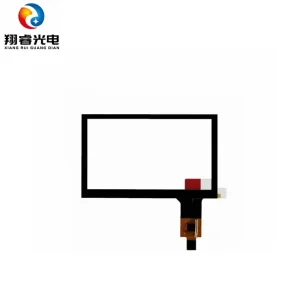
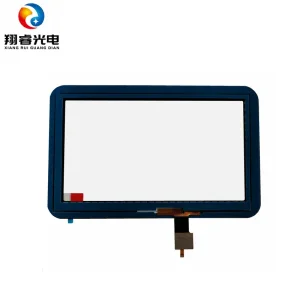
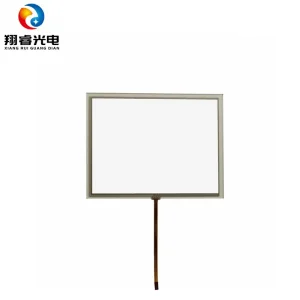
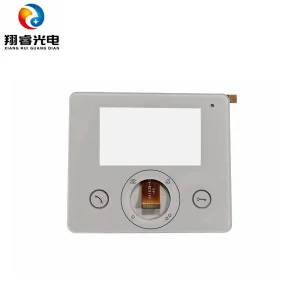
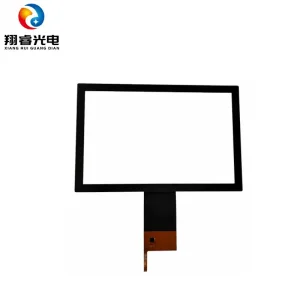
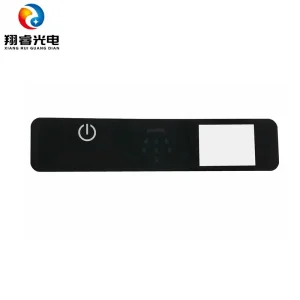
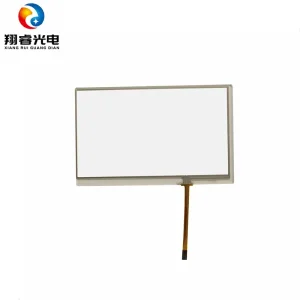
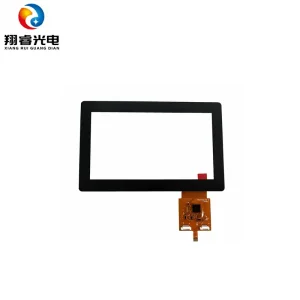
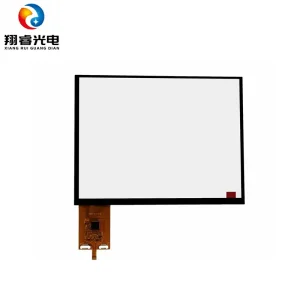
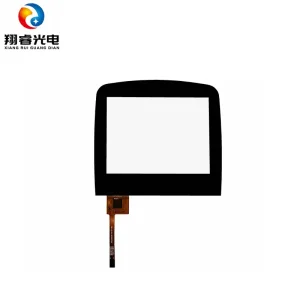
Explore our custom capacitive and resistive touch panels, built for wide-temperature operation and demanding environments.
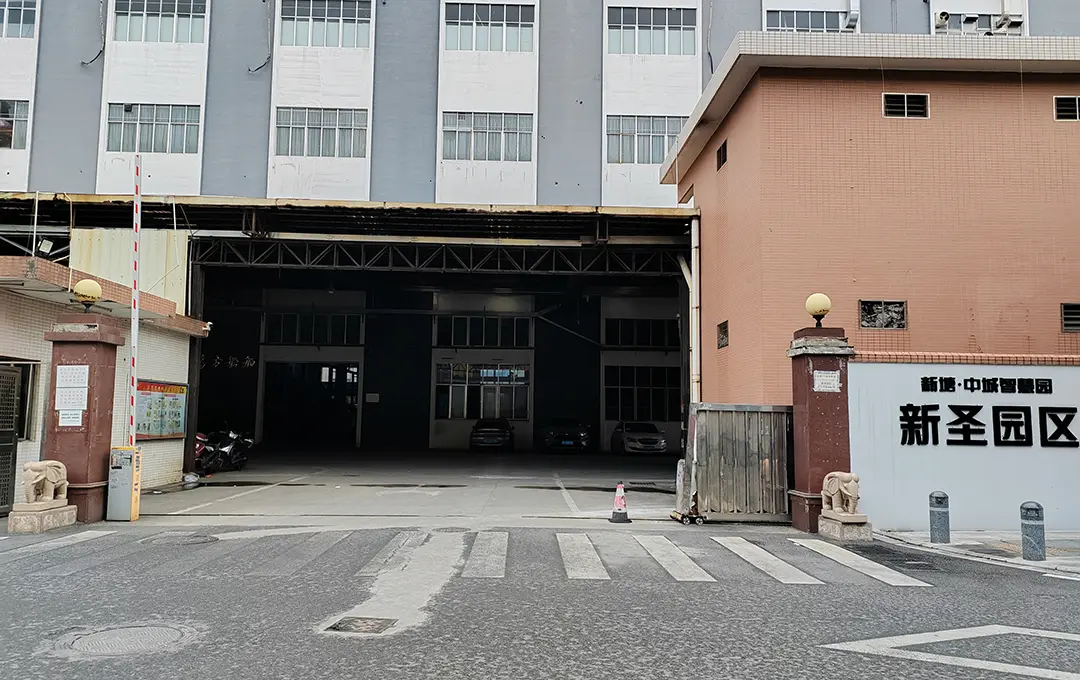
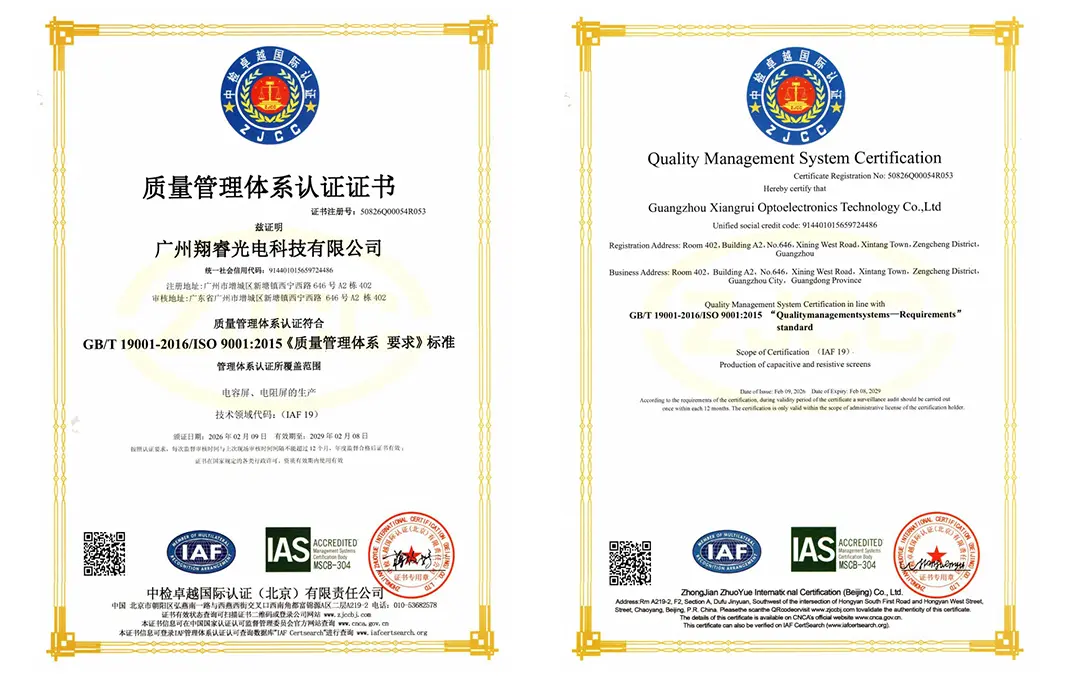
Established in 2010 in Guangzhou, China, Guangzhou Xiangrui Optoelectronics Technology Co., Ltd. is a recognized high-tech enterprise specializing in the design, development, manufacture, and distribution of advanced resistive and capacitive touch panels. With a decade-long track record, our production framework integrates state-of-the-art optical bonding processes with highly customizable cover glass solutions. We serve as a trusted OEM/ODM partner to top-tier international brands seeking touch display modules optimized for rigorous applications.
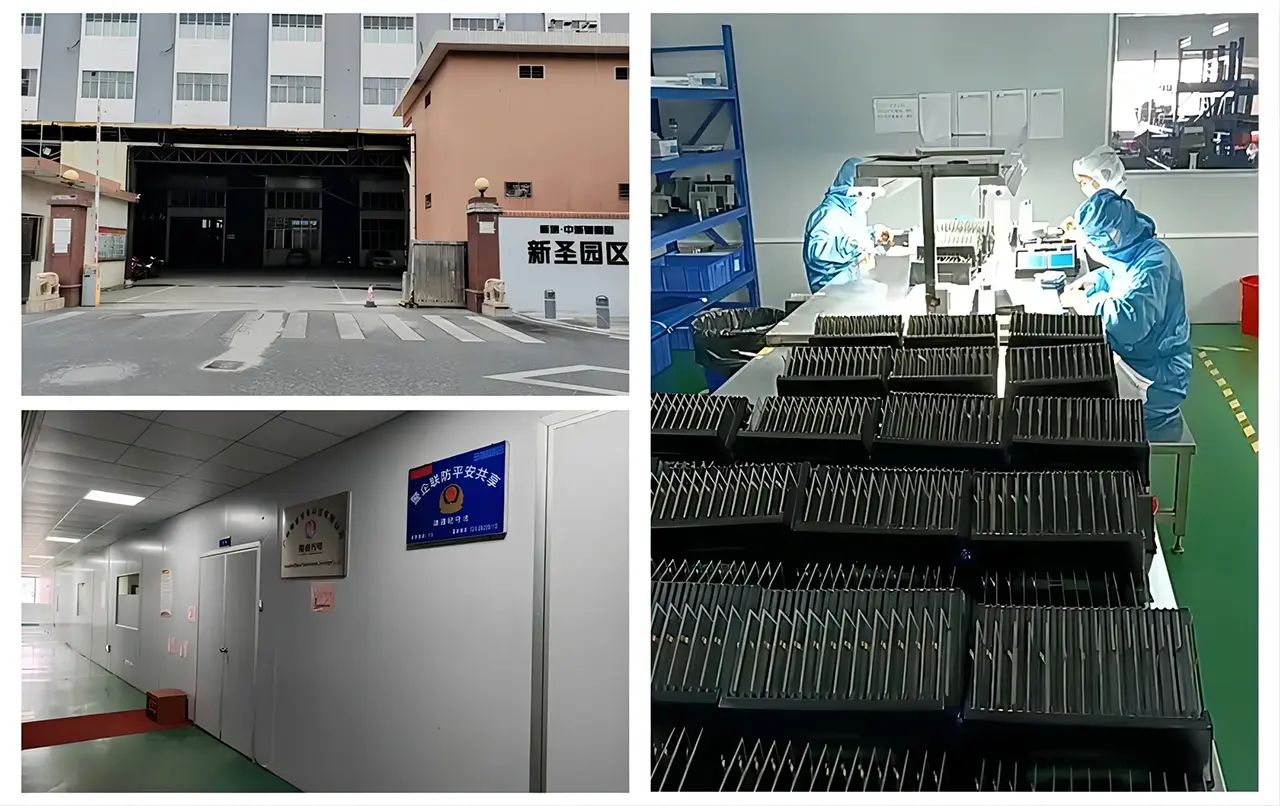
Our infrastructure features a 3,000 square meter modern plant, complete with Class 100, Class 1,000, and Class 10,000 dust-free cleanrooms. This advanced layout is designed to meet strict particulate contamination controls required for precision lamination, cover lens chemical hardening, and optical bonding. Backed by ISO 9001 and ISO 14001 certifications, we enforce strict quality standards, ensuring all systems meet global regulatory mandates and display long-term reliability.
Understanding why 10-inch and 10.1-inch modules are the global standard for industrial, commercial, and automation control interfaces.
In industrial automation, medical diagnostics, and smart interactive kiosks, the 10-inch form factor (including 10.1" and 10.4" variants) represents the ideal design balance between visual canvas size and chassis space constraints. It provides enough surface area to support complex graphical user interfaces (GUIs), multi-window telemetry readouts, and responsive numeric entry pads, while remaining compact enough to be integrated into portable medical equipment, CNC console terminals, and high-density wall-mounted controllers.
For hardware engineers, sourcing high-performance 10-inch touch screens requires balancing optical clarity with robust physical durability. Standard consumer displays quickly fail under harsh conditions like high electromagnetic noise, ambient moisture, extreme operating temperatures, and mechanical impacts. This is where industrial-grade touch modules—incorporating chemically strengthened cover glass, optical bonding, anti-reflective treatments, and specialized controller ICs—provide reliable long-term performance.
From clean medical operating rooms to heavy marine cockpits, our touch screens are engineered to deliver reliable inputs.
In hospital settings, touch interfaces must support latex-gloved operation and tolerate regular cleaning with chemical disinfectants. Our 10.1-inch capacitive panels feature tailored tuning parameters to detect multi-finger touch through sterile gloves and fluid layers, ensuring uninterrupted performance in critical patient monitors and diagnostic consoles.
Factory floors contain electromagnetic interference (EMI) from variable-frequency drives, high-power motors, and welding equipment. By using premium controller ICs from EETI and Ilitek, our panels filter out electrical noise, preventing ghost touches. Their IP65-rated enclosures keep dust, condensation, and oils out of internal components.
Public-use kiosks require impact-resistant cover panels to protect against accidental damage and vandalism. We apply chemically tempered soda-lime glass with surface hardness values exceeding 7H. Combined with anti-glare (AG) and anti-fingerprint (AF) coatings, this ensures high clarity and easy maintenance in self-checkout terminals.
A clear breakdown of resistive vs. capacitive touch technologies, along with the performance benefits of optical bonding.
| Performance Feature | Projected Capacitive (PCAP) | Analog Resistive (4/5-Wire) | Optical Bonding Upgrade |
|---|---|---|---|
| Touch Inputs | Multi-touch (up to 10 points), gestures | Single touch, high-pressure styling pen | No change to inputs, improves sensor accuracy |
| Optical Transmission | > 88% (standard assembly) | > 78% to 82% (due to air gaps) | Raises transmission to > 94% |
| Surface Durability | Chemical toughening, Mohs 7H+ scale | PET film layer, vulnerable to sharp objects | Adds mechanical stability, impact dampening |
| Moisture Resistance | High; design filters water spray | Excellent; functions when completely wet | Prevents internal fogging and condensation |
| EMC Performance | Dependent on controller tuning (EETI/Ilitek) | Inherently immune to ambient electromagnetic noise | Unchanged; shielding layers can be added |
At Guangzhou Xiangrui Optoelectronics, our technology roadmap focuses on developing touch modules that operate reliably in demanding environments. Our R&D efforts target key performance benchmarks:
How our integrated factory setup ensures quality control, stable material sourcing, and quick lead times.
Guangzhou's position as a global manufacturing hub allows us to manage an integrated and resilient supply chain. By sourcing raw display components, cover glass, and controller chipsets locally, we mitigate international logistics risks and maintain consistent production schedules. Our in-house manufacturing process covers every stage of assembly, from cover glass cutting and chemical tempering to cleanroom lamination and final testing.
This complete vertical integration enables us to offer prototype designs within 7-10 working days and rapidly scale to high-volume production. Our cleanrooms feature automatic lamination lines and precision laser trimming, ensuring high yield rates and dimensional accuracy. By managing production in-house, we control costs and protect client designs and intellectual property.
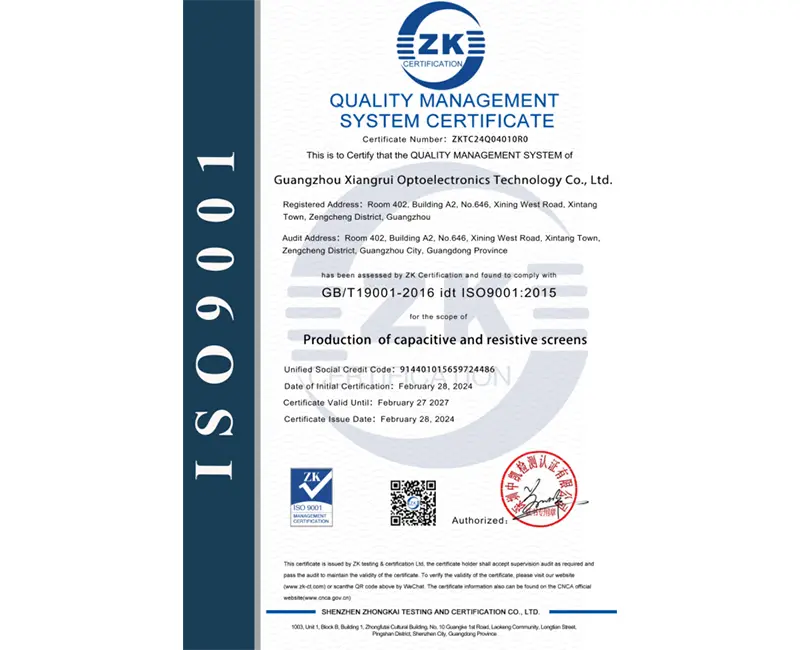
A look at our key growth milestones, technological steps, and certifications over the past decade.
From raw material sourcing to localized technical support, we help you resolve display challenges.
We enforce raw material inspection, mid-production functional checks, and automated optical inspections (AOI) to ensure every touch display module meets high performance standards.
Our factory is certified to ISO 9001 and ISO 14001. All display modules meet RoHS, REACH, CE, and FCC standards, simplifying integration into your target markets.
Backed by over 30 patents, we develop custom solutions like noise-filtering FPC layouts and optimized controller firmware to prevent ghost touch inputs.
Guangzhou Xiangrui Optoelectronics focuses on building long-term customer partnerships based on technical support, consistent quality, and on-time delivery. We collaborate closely with engineers and purchasing teams to align designs with precise physical and electrical requirements.
By integrating layout design, sensor assembly, glass treatments, and chip tuning under one roof, we streamline communication, speed up project timelines, and deliver reliable touch panel displays.
Answers to common engineering questions regarding the customization, integration, and reliability of our touch screens.
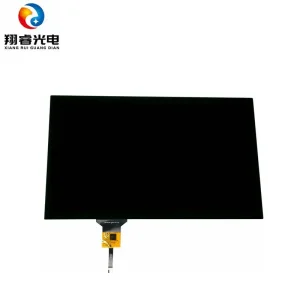
From compact touch buttons to wide-format industrial screens, browse our customizable solutions.
 Xiangrui Optoelectronics