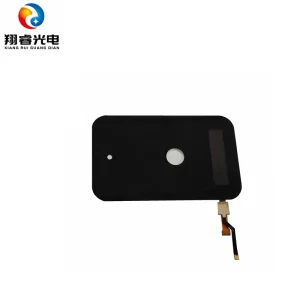
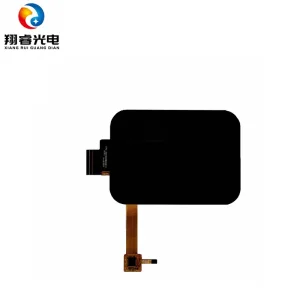
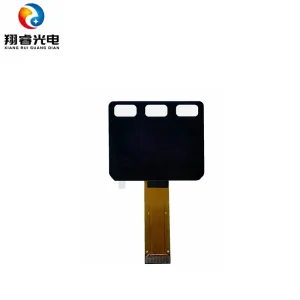
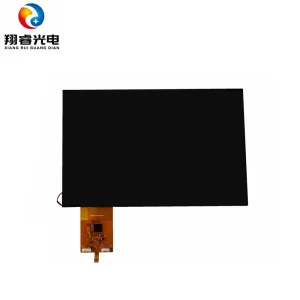
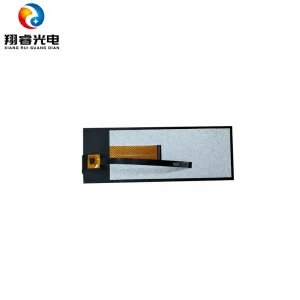
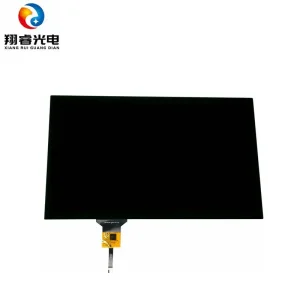
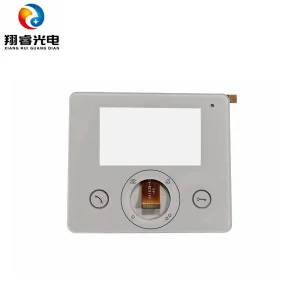
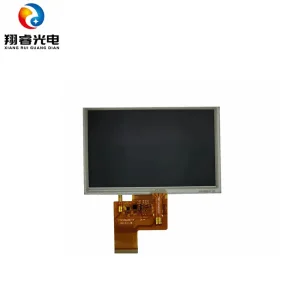
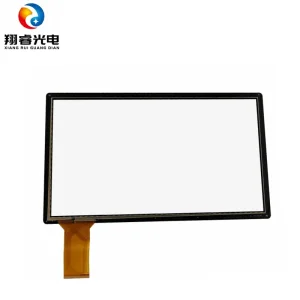
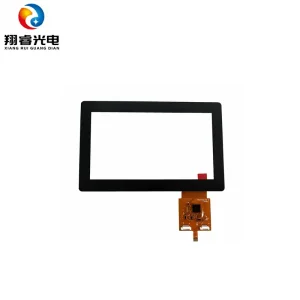
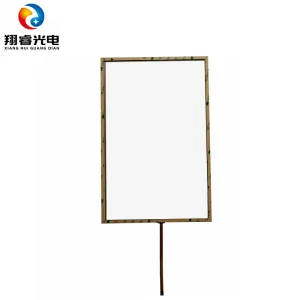
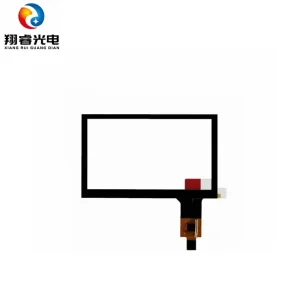
Explore our high-performance display modules, optimized for superior optical clarity, mechanical strength, and environmental resilience.
In standard display assemblies, an air gap exists between the cover glass (or touch panel) and the underlying LCD or OLED module. This air gap, while simple to manufacture via perimeter tape bonding (frame fitting), presents severe optical and mechanical limitations. Whenever light travels through media with different refractive indices (such as air with an index of $n \approx 1.0$, and glass/acrylic with an index of $n \approx 1.5$), it undergoes Fresnel reflection. This creates internal reflections that significantly degrade display readability, contrast ratio, and luminance under high ambient light conditions.
Optical bonding eliminates this internal air gap by filling it completely with an Optically Clear Adhesive (OCA) or Liquid Optically Clear Adhesive (LOCA) / Liquid Optically Clear Resin (LOCR) that matches the refractive index of the glass (typically $n \approx 1.49$). By matching the refractive indices, the transition boundary is effectively eliminated, reducing internal reflections from approximately 8.5% down to less than 0.2%. This physics-based optimization dramatically enhances contrast ratios under direct sunlight, ensuring critical information remains readable without increasing the backlight’s power consumption, thereby extending display life and reducing thermal loads.
| Performance Metric | Traditional Air-Gap (Frame Fitting) | Refractive-Index Matched Optical Bonding |
|---|---|---|
| Total Reflection Rate | ~8.5% to 10% (High glare) | <0.5% to 0.2% (Low reflection) |
| Sunlight Readability | Poor (Requires extreme backlight brightness) | Excellent (Clear under direct sunlight) |
| Condensation / Fogging | High risk in humid environments | Zero risk (Hermetically sealed display) |
| Impact Resistance | Low (Risk of cover glass shattering into display) | High (Adhesive absorbs and distributes impact energy) |
| Parallax Effect | Noticeable (Gap creates coordinate deviation) | Zero Parallax (Direct touch-to-pixel alignment) |
As a leading optical bonding manufacturer, Guangzhou Xiangrui Optoelectronics employs both major technology pathways depending on the specific application, size, and layout geometry of the displays. Understanding these methodologies is critical for choosing the right service for your customized displays.
LOCA represents a liquid-based dispensing process using specialized silicone or acrylic-based resins. The liquid adhesive is precisely dispensed in a cleanroom environment using multi-axis CNC gantries. The display and cover glass are laminated under vacuum to prevent bubble formation, followed by a UV pre-cure and a final thermal or UV cure stage.
Key Advantages: Highly recommended for large displays (>15.6 inches), uneven or curved cover lenses, or assemblies with complex ink borders. It provides excellent stress relaxation, preventing the "mura" (uneven light leakage) effect on sensitive LCD panels.
OCA utilizes dry-film sheets of solid adhesive. These sheets are pre-cut to match the active area of the display and laminated under high pressure and vacuum using precision roll laminators. Autoclaves are subsequently used to eliminate any micro-bubbles remaining along the edges of the lamination zone.
Key Advantages: Outstanding thickness control, zero risk of adhesive run-out or overflow during processing, and faster cycle times. OCA is highly suited for smaller, high-volume consumer or handheld devices such as wearable 1.54-inch displays and palm-print recognition systems.
Founded in 2010 and located in Guangzhou, China, Guangzhou Xiangrui Optoelectronics Technology Co., Ltd. is a specialized enterprise dedicated to the research, development, production, and custom assembly of resistive touch panels, capacitive touch panels, cover glass, and high-performance module optical bonding products. Over the past decade, we have established ourselves as an industry-standard manufacturer providing tailored OEM and ODM services.
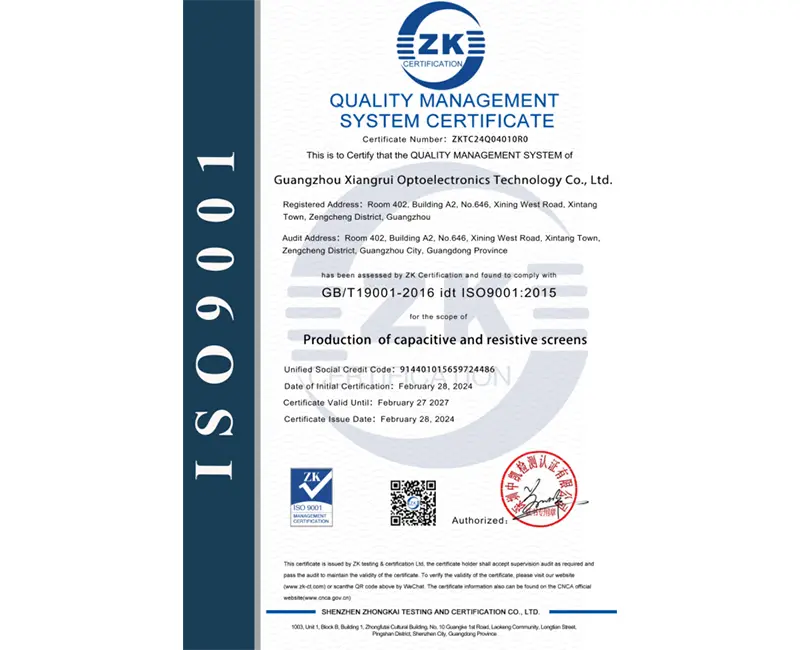
Our manufacturing facilities feature state-of-the-art cleanrooms (Class 100, Class 1000, and Class 10000) that meet the strict clean-level requirements of optical lamination. We are certified under ISO 9001 and ISO 14001, ensuring that every touch screen and bonded display we deliver meets international standards for quality, environment, and reliability.
Optical bonding is not a one-size-fits-all solution. Different operating environments present unique challenges that require tailored optical and material optimizations. Here is how Guangzhou Xiangrui Optoelectronics customizes its optical bonding services for specific localized industries:
Factory floors subject touch panels to vibration, dust, and dynamic temperature variations. Our bonded screens, such as our wide-temperature 10.1-inch and 15.6-inch capacitive panels, carry an IP65 protection rating. By eliminating the internal air gap, condensation and dust ingress are structurally prevented, ensuring stable, multi-touch performance in challenging settings.
Medical environments require touch panels that can withstand repeated chemical cleanings with isopropyl alcohol or bleach. Our optical bonding service laminates chemically-strengthened cover glass to displays, providing a completely flat surface with no dirt traps, ensuring compliance with strict clinical sanitization protocols.
High-humidity environments lead to internal condensation in traditional air-gap screens, rendering them unreadable. Xiangrui’s optical bonding acts as a barrier, preventing moisture from condensing inside the display stack-up. Combined with anti-reflective (AR) and anti-glare (AG) coatings, this ensures high legibility under changing weather conditions.
Guangzhou’s location within the Pearl River Delta provides access to one of the world's most concentrated electronics supply chain ecosystems. At Guangzhou Xiangrui Optoelectronics, we leverage this geographic location to optimize our manufacturing workflow, raw material sourcing, and logistics.
Our integration of display sourcing, cover glass processing, capacitive sensor manufacturing, and final optical bonding lamination under one roof reduces handling risks and production lead times. By eliminating intermediate shipping, we minimize the potential for particulate contamination and mechanical stress between assembly stages.
Additionally, our supply chains utilize high-performance, domestically and internationally sourced raw materials (including premium UV curable resins and specialized cover glasses). This multi-tier material sourcing strategy shields our clients from global supply chain disruptions, allowing us to maintain stable production runs and predictable delivery times for international OEMs.
The display market continues to demand thinner profiles, larger form factors, and integration with flexible and curved interfaces. As technology evolves, standard optical bonding methodologies must adapt to support these advanced integration standards.
The expansion of curved dashboard designs in modern automotive and industrial control panels requires precise, flexible bonding solutions. We are continuously refining our OCA and LOCA lamination processes to accommodate complex three-dimensional curves, maintaining even thickness across non-flat profiles.
To prevent display mura and structural stress on sensitive OLED and high-resolution LCD panels, our chemical R&D partners are developing ultra-low viscosity resins that cure with minimal volumetric shrinkage. This protects fragile microcircuitry while maintaining excellent mechanical adhesion.
Future touch screens will increasingly require multi-functional surface coatings directly integrated into the optical stack-up. We are actively combining our lamination processes with advanced hydrophobic, anti-microbial, anti-glare, and anti-fingerprint nano-coatings to meet high durability requirements.
Guangzhou Xiangrui Optoelectronics maintains rigorous quality standards throughout our design and manufacturing workflows. Our adherence to international compliance frameworks ensures that our touch panels and optical bonding services meet environmental and safety regulations globally.
Our adhesives and raw materials are verified free from restricted hazardous substances, ensuring compliance for EU and US markets.
Certified quality management ensures repeatable process controls, tracking trace materials from incoming inspection to delivery.
Certified environmental management guarantees that our factory emissions, waste handling, and power footprint remain sustainable.
Our customized optical bonding stack-ups are engineered to support IP65, IP67, or higher enclosure designs for wet environments.
Technical and practical answers from our optoelectronic engineers to assist you with display integration projects.
A wider selection of resistive, capacitive, and customized frame-fitting options built to your exact design parameters.
 Xiangrui Optoelectronics