Engineered for extreme performance, high light-transmission, and rugged structural integrity.
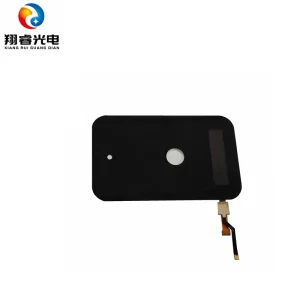
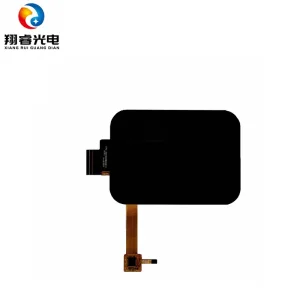
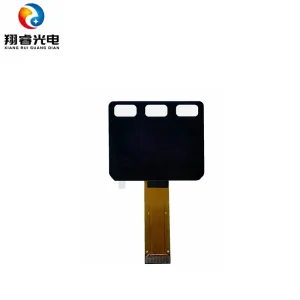
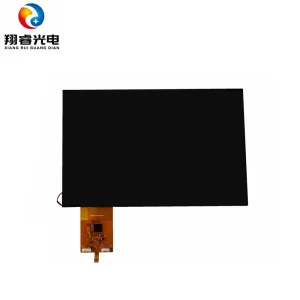
Bridging Advanced Optoelectronic Manufacturing with Luxembourg’s High-Tech and Space Industries.
Luxembourg has rapidly transformed into a premier European hub for high-technology development, spatial informatics, cyber-physical systems, and automated logistical nodes. As companies in regions like Esch-sur-Alzette, Differdange, Dudelange, and the capital city of Luxembourg push the boundaries of industrial automation and smart infrastructure, the need for robust, sunlight-readable, and highly durable display interfaces has grown exponentially.
Optical bonding is the technical process of applying a layer of liquid optical gel (LOCA) or dry optical sheet (OCR) between the touch sensor panel and the cover glass or LCD. By eliminating the air gap, optical bonding significantly increases the mechanical ruggedness of the screen, improves light transmission by over 90%, reduces glare/refraction from ambient light, and prevents the ingress of moisture, dust, or chemical cleaning solutions—critical parameters for Luxembourg's automotive assemblies, marine sensors, cleanroom pharmaceutical laboratories, and harsh outdoor EV charging systems.
Whether for high-altitude satellites, heavy-duty industrial interfaces operating in central European microclimates, or secure interactive kiosks for Luxembourg's booming financial services sector, our specialized display bonding configurations offer unprecedented optical clarity and anti-vibration qualities.
Standard air-gap bonding creates two internal reflective surfaces, causing up to 8.5% loss in display brightness. By matching the refractive index of the display stack, optical bonding reduces light reflection to below 0.2%, dramatically enhancing legibility under direct sunlight without overdrawing power or shortening LCD lifetimes.
Our optical bonding modules are tested under stringent international conditions to meet:
• IP65 / IP67 Ingress Protection
• MIL-STD-810G Shock/Vibration
• UL94-V0 Flammability Class
• Operating Temps: -40°C to +85°C
Providing direct manufacturing excellence to Luxembourg since 2010.
Founded in 2010 and based in Guangzhou, China, Guangzhou Xiangrui Optoelectronics Technology Co., Ltd. is a globally verified designer, developer, and manufacturer of capacitive touch panels, resistive touch panels, cover glass, and module optical bonding configurations. By integrating structural R&D with modern cleanroom engineering, we supply industrial projects in over 40 countries, adapting products for strict European quality requirements.
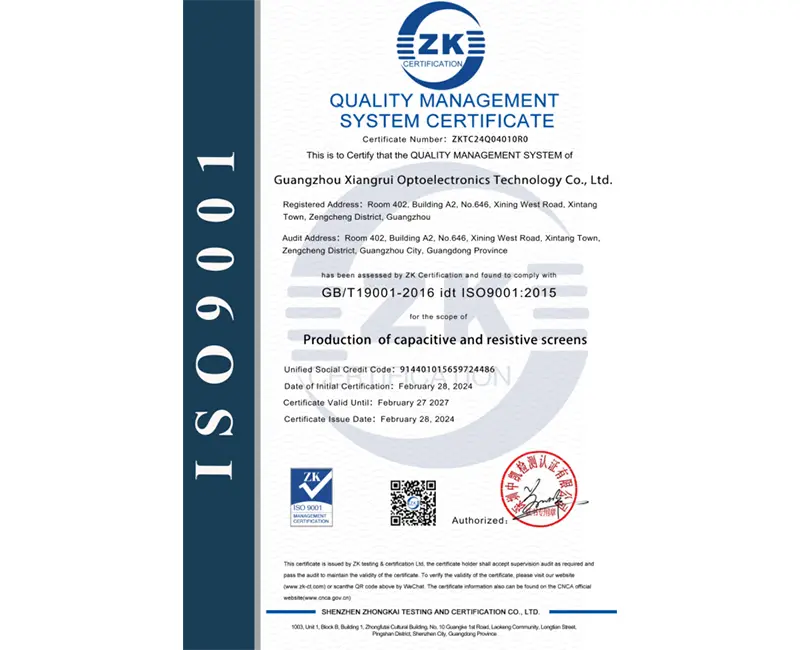
Standardized System Quality: We run fully certified ISO 9001 and ISO 14001 factories, ensuring that every touch screen and bonded panel passes standard quality gates before departure. Our raw glass, optical resins, and ITO films are sourced from industry-leading chemical suppliers, yielding high reliability.
Custom Engineering (OEM/ODM): We specialize in high-mix custom specifications. From customized cover lenses (up to 15mm thick for impact resistance), custom anti-reflective (AR), anti-glare (AG), and anti-fingerprint (AF) treatments, to special integration geometries (curved touchscreens, custom tail exit placements), we design touch surfaces that exactly fit your enclosure mechanical envelopes.
Understanding the differences in bonding methods to optimize cost, aesthetics, and reliability.
Using liquid-state optical resins cured under ultraviolet (UV) radiation or thermal chambers. Ideal for uneven surfaces, large format displays, and panels requiring excellent gap-filling. LOCA provides maximum light transmission and high vibration dampening.
Utilizes pre-cured, pressure-sensitive solid film sheets. Excellent thickness control across small to medium-size displays. This clean, efficient dry-bonding method is extensively used in wearable electronics, smartphones, and handheld instrumentation.
Employs soft silicone-based sheets or cured pads. Ideal for military, aviation, and offshore marine displays where the panel must withstand massive thermal shocks (-55°C to +100°C) and be reworkable without destroying the expensive TFT panel.
To guarantee zero bubbles, zero dust specks, and uniform adhesive layers, our production line consists of separate, humidity-controlled Class 100 (ISO 5) and Class 1,000 (ISO 6) cleanrooms for lamination and inspection, and Class 10,000 (ISO 7) for secondary assembly.
How we meet the quality and delivery criteria of European and international enterprises.
Global system integrators and machine builders demand strict supply-chain transparency and document packages. When purchasing touch display modules, engineering teams require component longevity, trace materials verification, and rapid prototyping capabilities.
To satisfy these expectations, we manage all tooling, FMEA (Failure Mode and Effects Analysis), and chemical composition profiles in-house. We ensure all materials used in the optical bonding stack strictly conform to the latest RoHS (Restriction of Hazardous Substances) and REACH (Registration, Evaluation, Authorisation and Restriction of Chemicals) directives.
For critical applications, we support custom glass treatments like chemical strengthening (corning gorilla glass equivalent), thermal tempering, thermal shock cycles, and anti-glare etching. This prevents panel delamination and ensures clarity under variable outdoor conditions.
✓ ISO 9001:2015 Quality Management Systems
✓ ISO 14001:2015 Environmental Audited Facilities
✓ CE / FCC Certifications for complete display systems
✓ IP65 Front Gasket integration designs
✓ IK08/IK10 Impact Ratings options for rugged cover glass
The future of interactive surfaces: integration, durability, and aesthetics.
As the digital landscape evolves, touchscreen integration is moving beyond flat, rectangular shapes toward complex 3D curved surfaces, flexible layouts, and thin micro-display architectures. At Guangzhou Xiangrui Optoelectronics, our continuous R&D efforts are focused on three main pathways:
Accommodating automotive dashboards and curved console arrays in smart vehicles. Dynamic curved bonding utilizes precise, non-planar pressure distribution jigs to achieve error-free optical coupling without inducing stress spots.
Meeting public transit kiosk requirements post-pandemic. We fuse custom nano-silver anti-microbial coatings on top of anti-fingerprint and hydrophobic overlays, enabling touch screens to kill up to 99.9% of common contact pathogens.
Designed for harsh outdoor environments. By sandwiching an infrared reflection filter (IR-cut) between the LCD and cover glass, the display panel temperature rise in direct sunlight is reduced by up to 15°C, preventing isotropic blackouts.
Frequently asked questions by process engineers and procurement managers.
Optical bonding eliminates the air gap between the display panel and the cover glass or touchscreen sensor. This results in:
1. Significantly improved readability: By eliminating reflections at internal optical boundaries, light loss from internal reflections is cut from 8.5% down to less than 0.5%.
2. Superior physical strength: The adhesive acts as a structural shock absorber, making the touchscreen up to 300% more resistant to mechanical impacts.
3. Condensation and dust elimination: Without an air gap, moisture cannot condense inside the display stack, preventing foggy displays under fluctuating temperatures.
Yes, our engineering team can custom design bonding stacks for almost any third-party display interface (including HDMI/LVDS TFTs, OLEDs, and e-paper modules). We build customized fixture designs in our machine shops to align panels, backlights, and cover lenses down to millimeter accuracy, ensuring uniform bond-line thickness (BLT).
We use specialized high-durability acrylic and silicone LOCAs that contain custom UV-stabilizing compounds. Our materials are rated to undergo severe Xenon arc weathering tests (equal to 10 years of direct solar exposure) with negligible changes to the yellowing index (delta YI < 1.0).
For initial structural drawings and glass mockups, we complete tooling blueprints in 3–5 working days. Physical prototypes (including custom glass cutting, sensor printing, and optical laminations) generally take 2–3 weeks depending on shape complexity and chemical treatment requirements.
Yes. While resistive panels require flexibility to register touches, they can still be optically bonded to the underlying TFT LCD module using soft gel sheets or pressure-cured optical adhesives. This configuration is widely deployed in legacy industrial terminals, outdoor logistics systems, and environments where gloved touch operations are mandatory.
Providing specialized touch solutions with complete cross-industry compatibility.
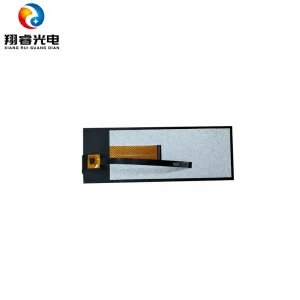
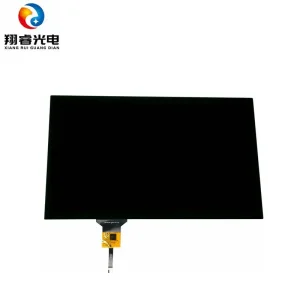
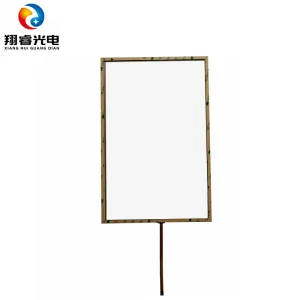
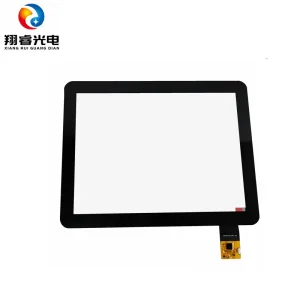
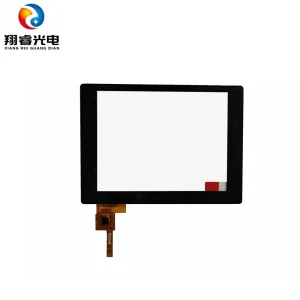
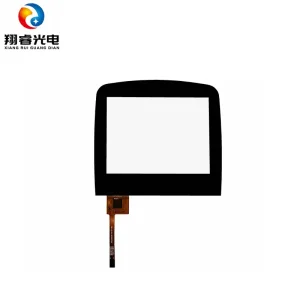
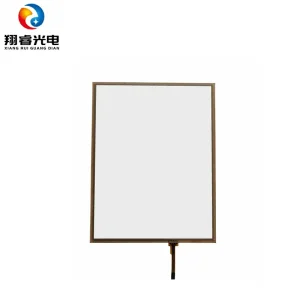
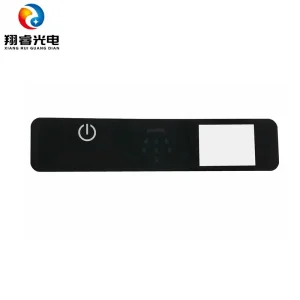
Speak directly with an application design engineer. Get professional feedback on layouts, materials, and price points within 24 hours.
 Xiangrui Optoelectronics