Optical Bonding, Resistive & PCAP Touch Screens Engineered to Strict Quality Standards
Analyzing E-E-A-T manufacturing standards, optical execution, and industrial deployment dynamics.
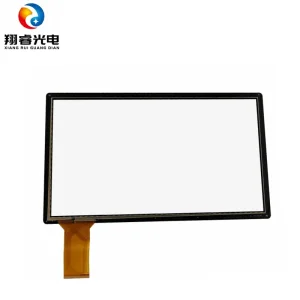
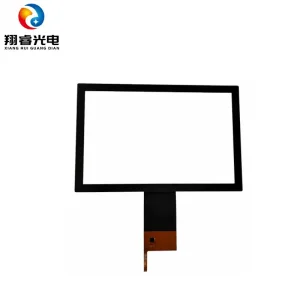
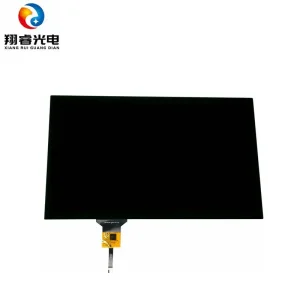
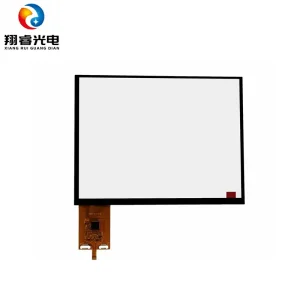
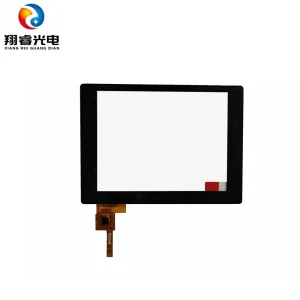
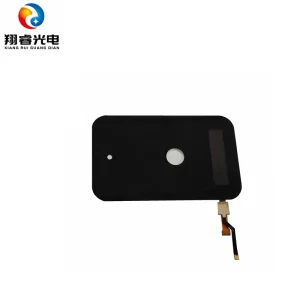
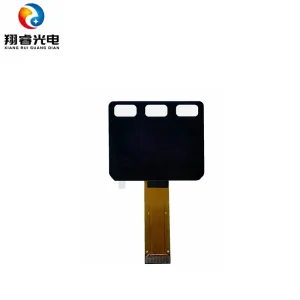
In the modern landscape of human-machine interaction, the demand for precision-engineered touch panels transcends basic desktop utilities. Guangzhou Xiangrui Optoelectronics Technology Co., Ltd., established in 2010 and situated in Guangzhou, China, has cemented its authority in the custom touch display domain. Serving as a dedicated powerhouse for research, development, production, and worldwide distribution of projection-capacitive (PCAP) and analog resistive touch screens, we specialize in high-end customized module bonding (optical and air bonding) and specialized cover glass options.
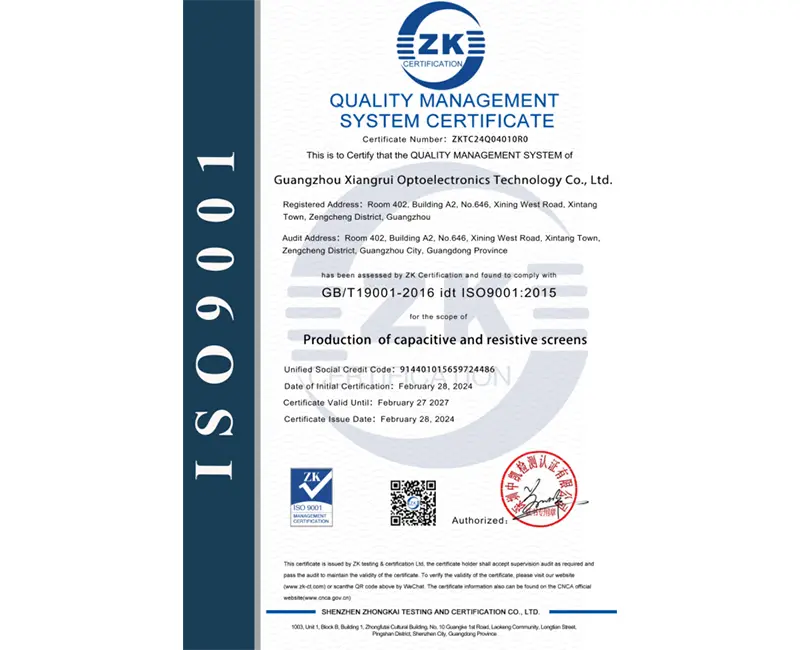
Operating within a fully integrated 3000 square meters manufacturing complex, we host specialized ultra-clean workspaces classified under Class 100, Class 1000, and Class 10000 cleanroom regulations. These dust-free standards are critical for zero-tolerance optic lamination, eliminating microscopic particulate contamination that degrades sensor signal-to-noise ratios (SNR). With certifications in ISO 9001:2015 Quality Management Systems and ISO 14001:2015 Environmental Protocols, our engineering teams ensure that every touch sensor matches rigorous global environmental and regulatory codes.
"Industrial environments do not tolerate failure. By aligning dust-free lamination with ISO-certified testing, we deliver touch solutions that perform flawlessly in electromagnetic zones, medical theaters, and outdoor terminals."
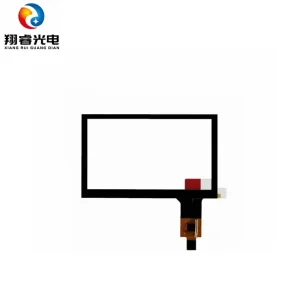
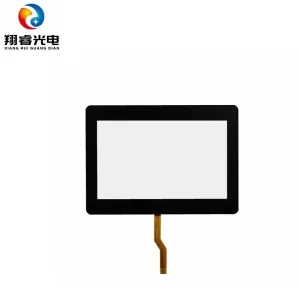
Selecting the ideal touch configuration is a pivot point for system architects. Projective Capacitive Touch Panels (PCAP) utilize a matrix of transparent Indium Tin Oxide (ITO) electrodes etched onto layer structures. As a user's finger approaches, it alters the localized electrostatic capacitance of the panel. A high-speed controller (such as EETI, Ilitek, or Microchip ICs) converts these subtle capacitance modifications into spatial coordinates. This permits multi-touch tracking, gesture support, and fluid scaling under protective cover sheets up to 10mm thick.
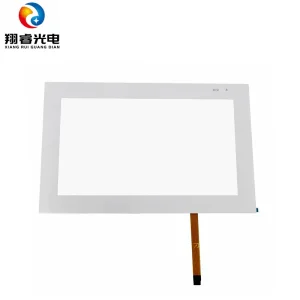
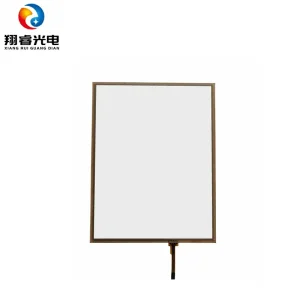
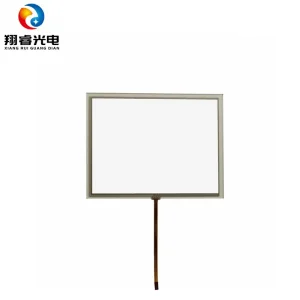
Conversely, Analog Resistive Touch Screens rely on physical contact to join two conductive layers (ITO film and ITO glass separated by micro-spacers). While limited to single-point or dual-touch tracking, resistive panels offer unparalleled immunity to electrical noise (EMI) and operate reliably regardless of the pointing device—be it gloved hands, stylus pens, or wet tools. They are the ideal choice for heavy industrial machinery, offshore marine instrumentation, and flight deck control panels.
| Engineering Attribute | Projective Capacitive (PCAP) Touch Panel | Resistive Touch Panel (4/5/8-Wire) |
|---|---|---|
| Operation Input Mode | Bare finger, conductive stylus, thin glove profiles | Gloved finger, bare skin, mechanical pointer, stylus |
| Surface Mechanical Hardness | Typically ≥ 7H Mohs (depending on chemically tempered glass) | Typically 3H (via outer PET protective film coating) |
| Optical Transmittance | ≥ 85% to 92% (dependent on Optical Lamination/Bonding) | 78% to 82% (affected by dual layers and air gaps) |
| Life Durability Index | Practically unlimited (>50 million touches at one point) | 10 to 35 million touches (mechanical degradation of layer adhesion) |
| Noise (EMI) Resistance | Requires controller tuning (software frequency hopping) | Inherent structural immunity to electrical interference |
| Environmental Protection | IP65 to IP69K sealed designs; chemically resistant covers | IP65 front bezel sealing; PET layer vulnerable to sharp impact |
For outdoor applications and harsh clinical configurations, standard air-gap bonding introduces major display limitations. The refraction index difference between the cover plate, air gap, and liquid crystal display causes light reflection loss of approximately 8.5%. This significantly degrades outdoor screen legibility.
Fills the physical gap using high-transparency Optically Clear Adhesive (OCA) tape or Liquid Optically Clear Adhesive (LOCA). This matches the glass refractive index, reducing ambient reflections to below 0.2% and improving contrast in direct sunlight.
Seals the inner sensor space completely, preventing moisture entry and internal condensation caused by temperature cycling.
Transfers mechanical impact forces across the entire structural sandwich, strengthening the assembly to pass IK08 to IK10 testing standards.
Guangzhou's position within the Pearl River Delta electronics manufacturing cluster gives us a unique supply chain advantage. The regional proximity to premium raw glass processing facilities (Corning, Schott, AGC), high-purity ITO targets, specialty FPC manufacturers, and driver IC vendors allows us to compress prototyping timelines while offering extensive customization.
Go from customized 2D design layouts to physical, functional samples in 12 to 18 business days.
Specify Anti-Glare (AG), Anti-Reflective (AR), and Anti-Fingerprint (AF) chemical etchings directly on cover glass up to 10mm thick.
Take advantage of vertically integrated assembly steps, from glass polishing to cleanroom lamination, to reduce overall production costs.
Touch panels must remain functional under varying operating conditions. Our customizable resistive and capacitive screens are engineered to perform reliably across diverse vertical applications:
Mounted in harsh industrial settings, our screens feature high EMI resistance (tested to 10V/m for susceptibility) to remain functional near high-voltage motor starters, welding systems, and robotics.
Designed with UV-absorbing optical resins to prevent solar yellowing, integrated with anti-glare coatings, and sealed to meet IP65 dust- and water-resistance requirements.
Engineered to support latex or nitrile glove operation. Designed with chemically strengthened cover glass that withstands repeated sanitization and cleaning cycles.
Combines custom aesthetic cover glass printing with slim, ultra-thin profiles to integrate seamlessly into modern smart home setups and payment interfaces.
The human-machine interface (HMI) market is rapidly evolving. We are tracking and implementing several key technological shifts:
Haptic Feedback Integration: Modern industrial control screens are transitioning from static surfaces to active interfaces. By integrating piezo-ceramic actuators behind the touch stack, our R&D team can simulate click, slide, and warning vibrations, allowing operators to feel key actions without looking directly at the screen.
Noise Cancellation & Smart Tuning: High-voltage environments often generate electrical noise. Advanced controller algorithms now utilize self-capacitance sensing combined with mutual-capacitance measurements to filter out interference, allowing the screen to work reliably when wet or under high EMI conditions.
Expert answers addressing the design, certification, and lamination of custom touch assemblies.
Complete product list featuring specialty form-factor capacitive and resistive interfaces
 Xiangrui Optoelectronics