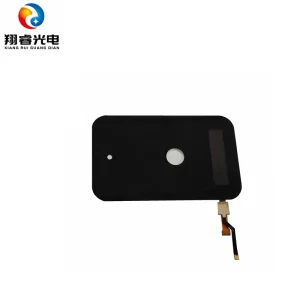
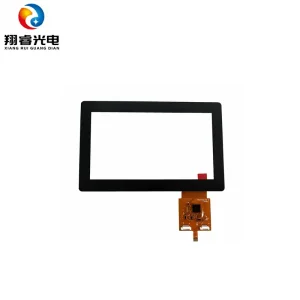
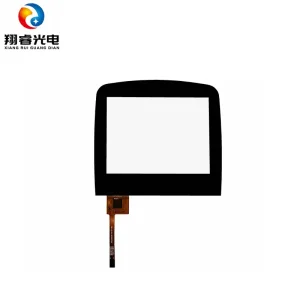
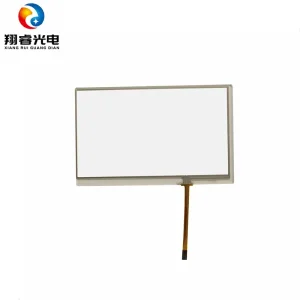
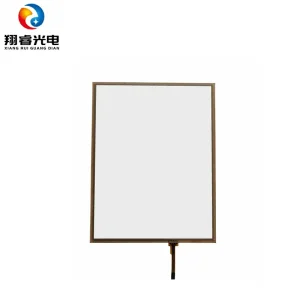
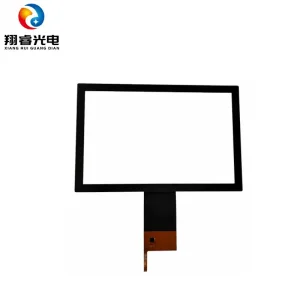
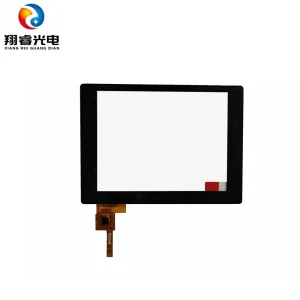
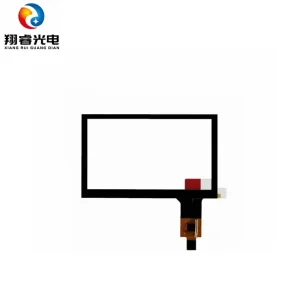
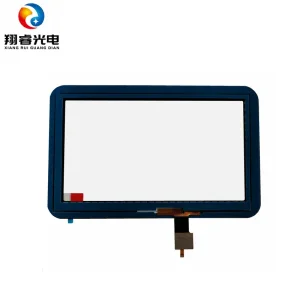
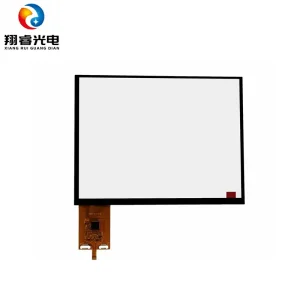
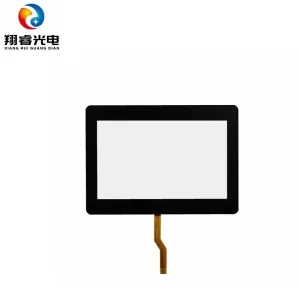
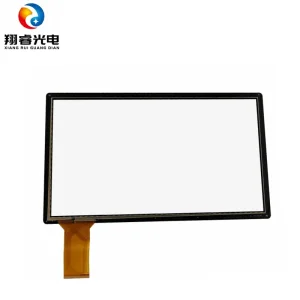
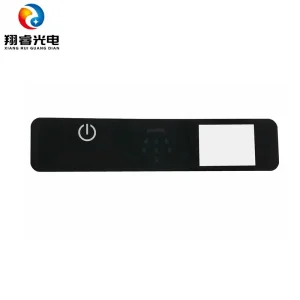
Explore our industrial-grade capacitive and resistive display integrations engineered for complex operating environments.
Guangzhou Xiangrui Optoelectronics Technology Co., Ltd. was established in 2010. Over the past decade, we have established ourselves as a premier high-tech enterprise in Guangzhou, China. We specialize in the research, development, custom engineering, and mass-scale production of high-performance resistive touch panels, projected capacitive (PCAP) touch screens, cover glass, and liquid crystal module (LCM) optical bonding solutions.
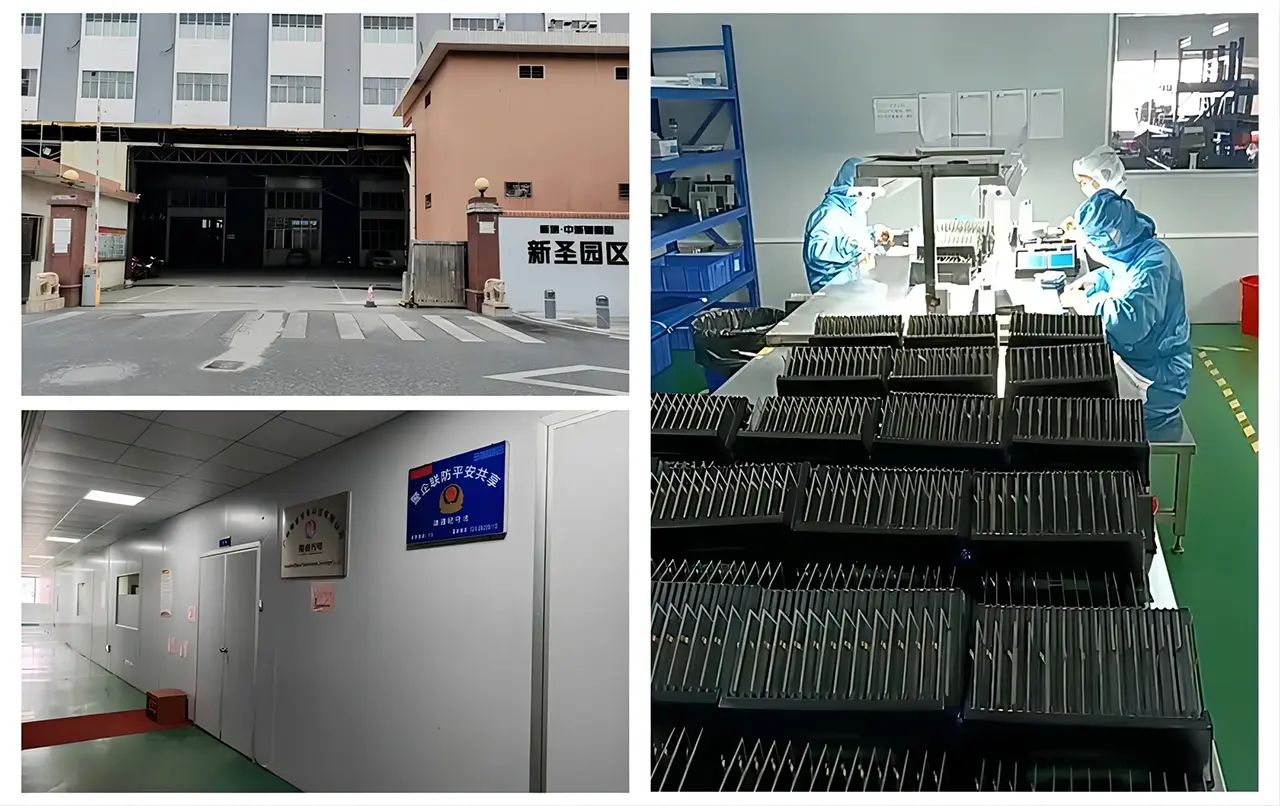
Supported by our modern 3,000 square meter plant area and a total factory footprint spanning approximately 10,000 square meters, our facility features Class 100, Class 1,000, and Class 10,000 dust-free cleanrooms. This advanced environmental control meets strict standards for multi-layer clean room laminations, optical adhesive bonding (OCA/OCR), and precision micro-soldering processes.
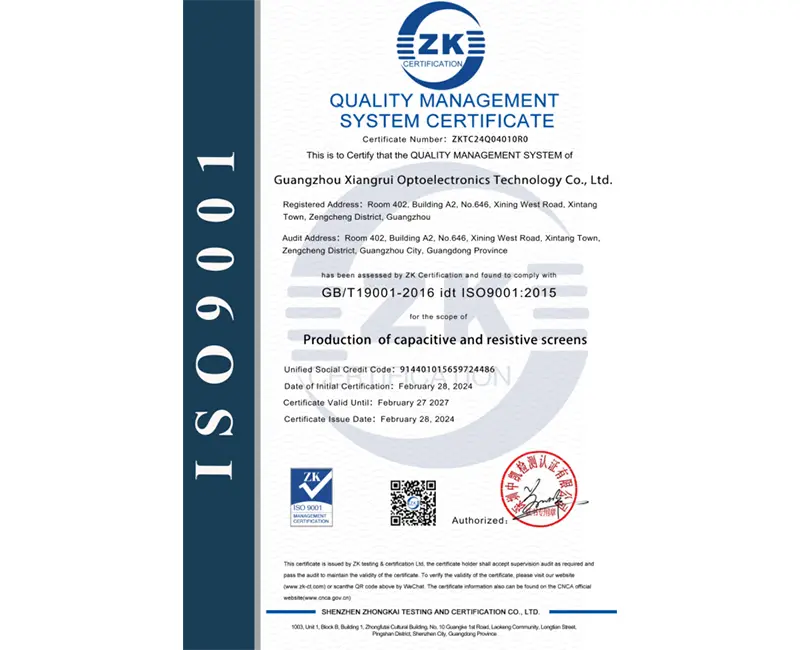
As an ISO 9001:2015 and ISO 14001:2015 certified manufacturer, our end-to-end quality assurance ensures that every touch sensor meets rigorous industrial and medical standards, including EN 60601-1 compliance for biomedical displays and IP65 standards for outdoor ingress protection.
A deep look at the structural, electrical, and optical properties that define industrial-grade touch displays.
17-inch touch screens serve as a standard size for heavy-duty industrial HMIs, maritime consoles, and medical imaging carts. Selecting the correct touch architecture is essential to operational reliability:
Guangzhou Xiangrui Optoelectronics optimizes both technologies, offering customized controller firmware (including EETI, Ilitek, and SIS ICs) tailored for water rejection, gloved touch, and thick cover-glass configurations up to 10mm.
In high-ambient light environments, traditional air bonding leaves an air gap between the touch screen and the underlying LCD panel, leading to internal light refraction, reduced contrast, and a higher risk of condensation or dust penetration.
Our Class 100 cleanrooms are designed for Optical Bonding (using Optically Clear Resin - OCR or Optically Clear Adhesive - OCA). Optical bonding eliminates the internal air gap, yielding key benefits:
How the 17-inch touch sensor form-factor is evolving to support next-generation intelligent interfaces.
As industrial enclosures require slimmer profiles and lighter displays, traditional ITO coatings are being complemented by Metal Mesh and Silver Nanowire (AgNW) technologies. These alternative conductors offer lower sheet resistance, enabling high responsiveness, curved display architectures, and support for multi-point touch detection under ultra-thick (up to 15mm) cover glass layers.
Future iterations of the 17-inch touch modules integrate smart touch controllers embedded with localized machine learning algorithms. These microprocessors predict finger trajectories, dynamic frequency hop to filter out high-frequency EMI noise from surrounding industrial machinery, and intelligently isolate water droplets or continuous fluid streams to prevent false-trigger actions.
Meeting standard sanitization and readability requirements, the future lies in hydrophobic, anti-microbial (biocidal silver ion), and nano-textured Anti-Glare (AG) cover layers. These technologies prevent microbial colonizations, ease display cleaning cycles, and improve touch feel while mitigating bright ambient glares.
Customized OEM 17-inch touch integrations designed for demanding industry verticals.
Guangzhou Xiangrui Optoelectronics collaborates with system integrators to build robust hardware solutions. A standard 17-inch display footprint (typically featuring a 5:4 or 4:3 legacy ratio) serves as the primary system-user interface across several industries:
UV-blocking glass coatings and optical lamination prevent polarization color shift and shield LCD panels from heat buildup under solar exposure.
Anti-reflective and anti-glare coatings, combined with saltwater-resistant touch controllers, ensure uninterrupted touch accuracy in open-sea environments.
Designed with wide temperature performance range (-20°C to +70°C operating limits) and highly robust thick FPC strain-relief tails.
How our vertically integrated South China factory guarantees quality control, scalability, and predictable lead times.
We source raw materials (soda-lime/aluminosilicate cover glass, premium ITO sensor films) from certified suppliers. Every batch undergoes strict spectral and dimensional testing before production.
Fine-pitch sensor circuitry etching and lamination are performed in high-grade cleanrooms, ensuring dust particles do not affect trace resistances or cause display flaws.
Fully automated bonding machines position the touch panel to the cover plate or LCD, reducing human variance and maintaining tight alignment tolerances (<±0.1mm).
Finished assemblies undergo thermal cycling chambers, high humidity tests, ESD testing up to ±15KV, and impact drop-ball validation prior to packaging.
Guangzhou Xiangrui Optoelectronics optimizes every step of the manufacturing pipeline. Our plant contains custom tooling machines for cover glass printing, CNC grinding, chemical tempering, and high-efficiency optical lamination. This integration minimizes outsourcing risks, protects intellectual property, and reduces design turnaround times.
By positioning our facility in the South China electronics manufacturing hub, we maintain reliable supply contracts with chemical glass tempered suppliers and IC component suppliers, maintaining stable pricing and consistent material pipelines for global buyers.
Simplifying the custom OEM engineering lifecycle with international standards and direct engineer-to-engineer communication.
We streamline the OEM workflow with clear design checkpoints. Provide your mechanical drawings (CAD/STEP files) or interface requirements, and our engineers will deliver detailed mockups within 3–5 working days. Rapid-prototype tooling allows functional sample delivery in 2–3 weeks, accelerating your overall time-to-market.
Our manufacturing flows operate under ISO 9001 and ISO 14001 certification frameworks. Products leaving our warehouse comply with CE, FCC, RoHS, and REACH directives. We provide materials documentation and safety data sheets to simplify international import clearance and compliance audits.
We provide long-term supply guarantees (typically 5 to 7 years) to protect industrial product lifecycles. Our FAE teams provide support for controller firmware tuning, OS driver integration (Windows, Linux, Android, macOS), and electromagnetic troubleshooting directly to your development team.
Get answers to common engineering questions concerning custom OEM 17-inch touch display integrations.
Yes. By utilizing industrial-grade touch controllers (EETI or Ilitek ICs), we adjust controller firmware to increase the sensor gain. This allows the touch panel to detect signal variations through heavy industrial work gloves (latex, nitrile, neoprene, or thick leather gloves up to 5mm). During the RFQ process, please specify the thickness and material of the gloves used in your operating environment so we can pre-configure the sensitivity threshold.
We provide extensive cover glass customization services. This includes glass thickness options from 0.7mm to 10mm, chemical tempering, and custom perimeter silk printing in any Pantone color. We also offer physical modifications like water-jet cutouts, rounded corners, drop-proof chamfered edges, and surface coatings such as Anti-Glare (AG), Anti-Reflective (AR), and Anti-Fingerprint/Anti-Smudge (AF/AS) coatings.
OCA (Optically Clear Adhesive) uses a solid dry film sheet and is suited for flat panels in mid-to-small display profiles. OCR (Optically Clear Resin) is a liquid-based UV curing adhesive, which is better for larger screens and thick cover glasses, as it fills uneven surface tolerances more effectively. For outdoor kiosks, both lamination processes eliminate the air gap, prevent condensation, and reduce screen reflection by 90% when combined with AR coatings.
Electrical noise from motors, inverters, and power supplies can disrupt capacitive touch systems. We address this by using multi-layer ITO designs with shielding layers, routing ground connections along the sensor frame, and using premium controller ICs with frequency-hopping technology. The touch controller monitors and dynamically shifts its operating frequency away from interference spikes to ensure reliable touch detection.
For custom cover glass shapes or custom flexible printed circuits (FPC), prototype drawings are generated in 3–5 working days. Prototypes are manufactured and shipped within 2–3 weeks following drawing approval. Upon sample validation, typical production runs are fulfilled within 4–5 weeks. This timeline can be optimized by establishing a rolling inventory forecast.
Yes, we support high-mix, low-volume (HMLV) orders for industrial, medical, and aerospace systems. While automated mass production lines run most efficiently at scale, we maintain dedicated production cells to support smaller orders (e.g., 50 to 100 units per batch) to help align with long industrial lifecycles.
From micro-interfaces to large-format ruggedized displays, discover our complete lineup of touch modules.
 Xiangrui Optoelectronics