Explore our comprehensive industrial-grade touch panels optimized for rugged configurations, high-definition clarity, and strict electromagnetic environments.
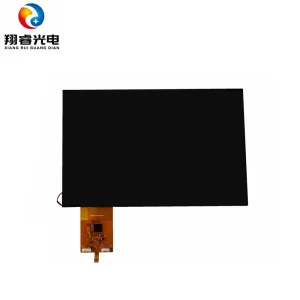
Founded in 2010 and located in Guangzhou, China, Guangzhou Xiangrui Optoelectronics Technology Co., Ltd. is a premier global enterprise dedicated to the research, development, production, and precision engineering of high-reliability touchscreen panels. Our technology portfolio spans advanced resistive touch screens, projected capacitive (PCAP) multi-touch panels, customized chemically strengthened cover glass, and state-of-the-art optical and frame bonding (LOCA/OCA) technologies.
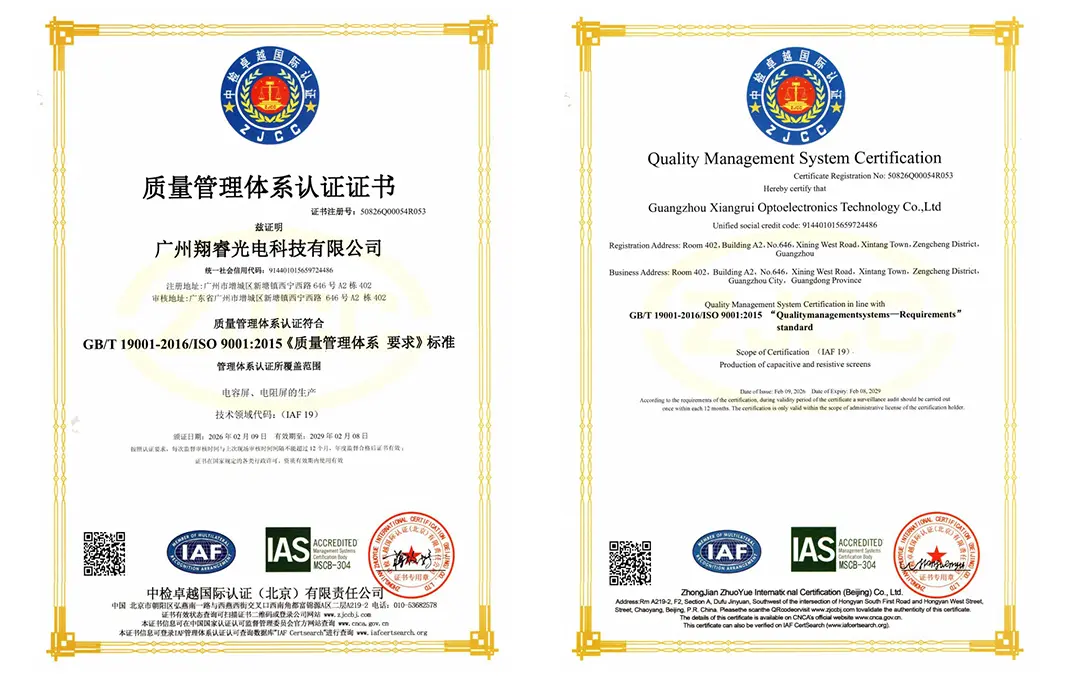
Backed by a highly specialized R&D department, we work closely with top-tier industrial designers, electronics hardware manufacturers, and medical device OEMs. In 2022, our commitment to technological breakthrough earned us the title of Guangdong Province High-Tech Enterprise. Our facility runs under highly standardized quality control protocols, holding certified compliance with ISO 9001:2015 and ISO 14001:2015.
From custom protective coatings (AG, AR, AF) to specialized interface controllers (EETI, Ilitek, COF/COB structures), we transform raw concepts into resilient interactive hardware tailored for rugged deployment environments worldwide.
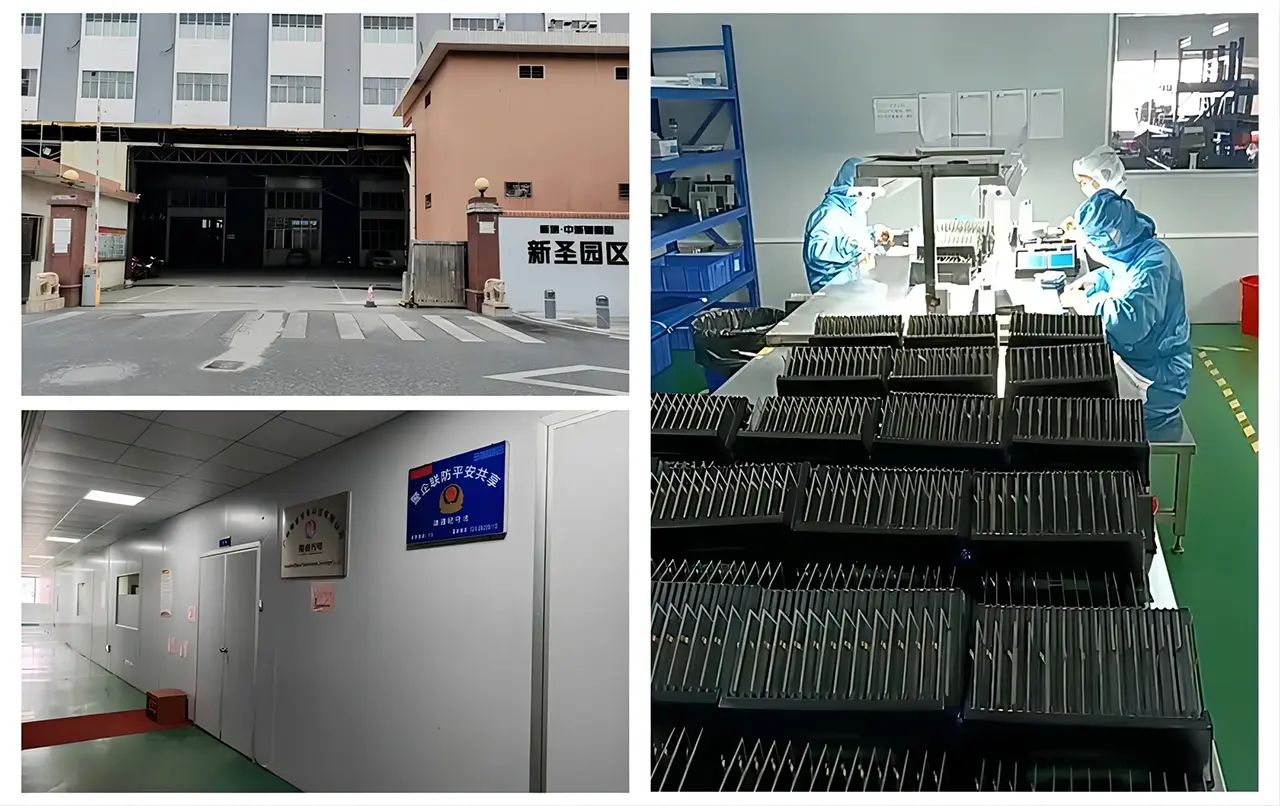
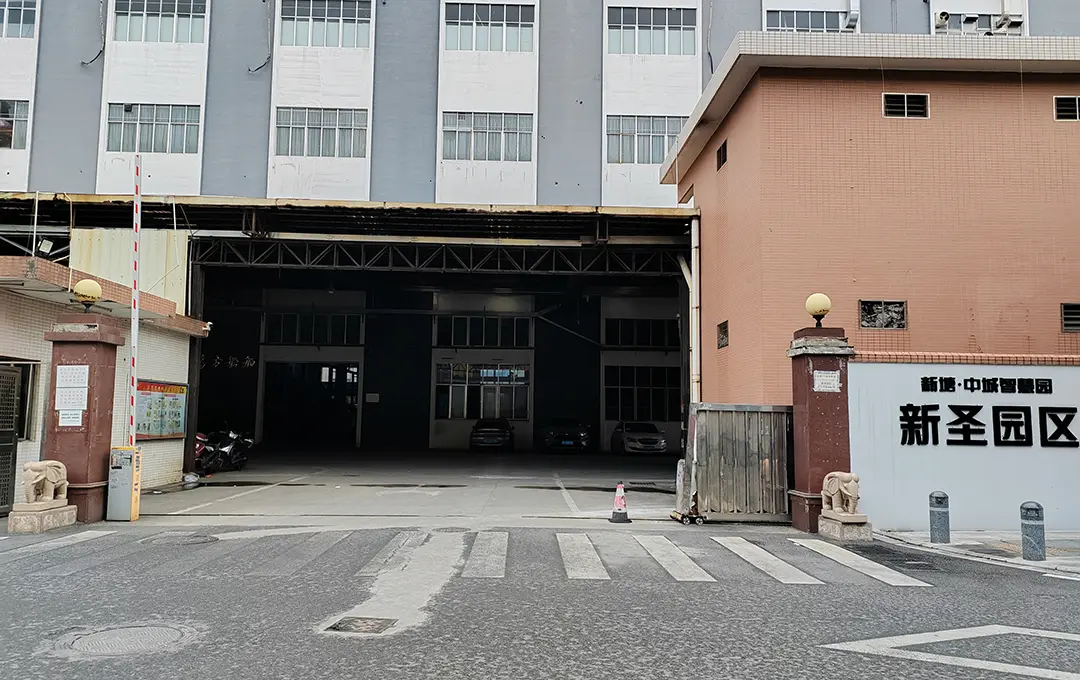
Our manufacturing capacity is driven by a massive, high-specification facility designed to prevent dust contamination, a critical requirement for precision optical lamination. Spanning a total cleanroom workshop footprint, our facility features strict isolation zones, including Class 100 (ISO 5), Class 1,000 (ISO 6), and Class 10,000 (ISO 7) environments to support various stages of screen lamination, printing, and inspection.
This allows us to maintain a zero-particle threshold during the optical bonding process of large-format touchscreens, including our custom 27-inch units. In addition, our manufacturing lines integrate automated laser cutting, precise CNC edge-grinding, automated ITO sensor etching, and dry/wet thermal chambers for environmental stress testing. This setup ensures that every module delivers impeccable optical clarity and consistent touch sensitivity over long lifetimes.
Analyzing global market demands, mechanical challenges, and integration paradigms for enterprise-level touch displays.
Large format displays like 27" screens act as large antennae. Industrial buyers require robust electromagnetic compatibility (EMC) controllers (e.g., EETI/Ilitek solutions) capable of filtering system noise, preventing ghost touches, and passing rigorous IEC 61000 standards.
Standard air-gap bonding often suffers from condensation, dust ingress, and low visibility due to internal reflections. Procurement managers prioritize optical bonding (OCA/LOCA) to optimize light transmission, decrease reflection index, and guarantee IP65 ingress protection.
Commercial products face rapid obsolescence, but industrial and medical devices demand a minimum of 7 to 10 years of consistent form-factor support. Guangzhou Xiangrui guarantees product footprint stability, eliminating redesign expenses for downstream manufacturers.
How 27-Inch customized touchscreen solutions solve key interface challenges across various industrial sectors.
Sterile medical interfaces demand support for thick surgical gloves, liquid spill rejection, and heavy chemical resistance (frequent cleaning with isopropyl alcohol). Our custom 27-inch G+G panels are calibrated for high durability, medical-grade compliance, and precision coordinate reporting.
Heavy machinery control panels require robust physical strength. We utilize chemically tempered cover glass up to 10mm thick, achieving high impact resistance. In addition, we design custom black matrix borders, integrated physical buttons, and visual cutouts for dual-operation safety.
Unattended public kiosks operate 24/7 and are susceptible to vandalism. Guangzhou Xiangrui offers IK08 to IK10 rated custom glass options combined with anti-fingerprint (AF) and anti-glare (AG) coatings to ensure continuous high visibility under direct overhead lighting.
To design the ideal 27-inch touchscreen, engineers must configure multiple mechanical and chemical layers. The table below represents our standard configuration parameters for large-format multi-touch screens.
| Parameters | Standard Configuration Range | Optional Tailored Upgrades |
|---|---|---|
| Technology | Projected Capacitive (PCAP) | Analog / Matrix Resistive Configurations |
| Structure | Glass-on-Glass (G+G) / G+F+F | Ultra-thin sensor layouts, Custom Curved Glass |
| Cover Glass Thickness | 1.1mm, 1.8mm, 2.0mm, 3.0mm | Heavy Industrial Chemically Tempered up to 10.0mm |
| Optical Coatings | Clear Glossy (Transmission > 88%) | Anti-Glare (AG), Anti-Reflective (AR), Anti-Fingerprint (AF) |
| Controller Solutions | Ilitek / EETI / Goodix COB (Chip On Board) | Chip on Flex (COF), specialized firmware for water/glove rejection |
| Interface Types | USB / I2C / RS232 | Custom pin-out configurations and tail orientation |
| Operating Temperature | -20°C to +70°C | Extended wide-temp rating (-30°C to +85°C) |
Our commitment to continuous innovation is key to maintaining high competitiveness in the human-machine interface market.
We are integrating localized piezo-electric actuator feedback beneath 27-inch cover lenses. This technology provides distinct tactile confirmation to medical personnel and heavy industrial operators, ensuring safer inputs without looking directly at the display.
As smart cockpits and curved control desks grow in popularity, our R&D team is developing flexible silver nanowire (AgNW) and metal mesh sensor matrices. This enables multi-touch capabilities on non-flat surfaces with tight bending radii.
Collaborating with controller IC design firms, we are deploying next-generation algorithms that dynamically sweep scanning frequencies. This technology isolates and suppresses up to 100Vpp of electromagnetic interference from electric motors, marine engines, and surgical equipment.
We operate on the fundamental principles of being people-oriented, honest, pragmatic, innovative, and collaborative. Our goal is to maintain strong competitiveness in a demanding market and achieve stable, rapid development for our customers.
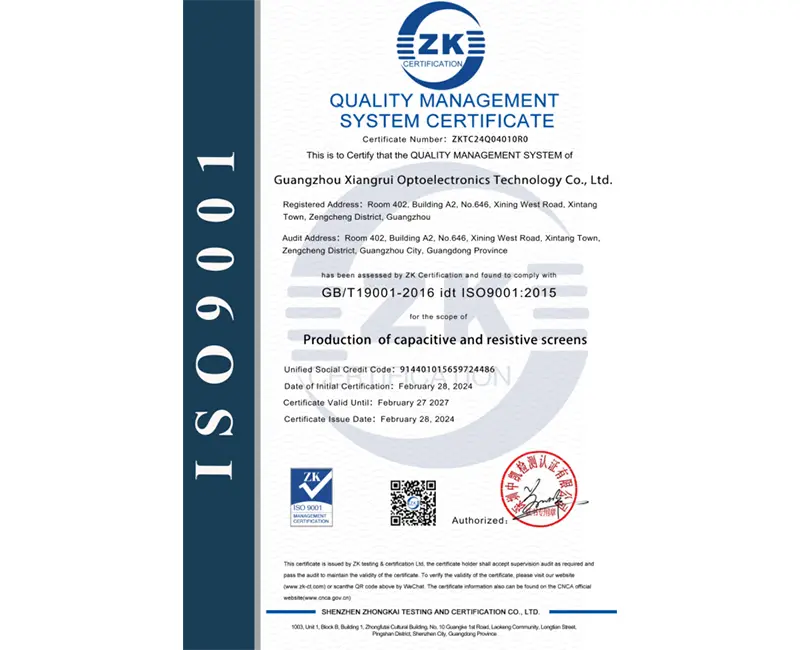
Deploying interactive hardware globally requires compliance with regional safety, environmental, and communications guidelines. Guangzhou Xiangrui ensures all customized products comply with regulatory standards:
Our raw materials conform to RoHS Directive 2011/65/EU and REACH requirements. For critical markets like North America and the European Union, our custom touch solutions support smooth integration into system-level CE, FCC, and UL certifications.
To ease deployment challenges, we provide comprehensive documentation, including detailed hardware datasheets, step-by-step controller firmware calibration manuals, and open-source Linux, Windows, and Android kernel drivers. Our engineering staff is available for video consultations to assist with touch sensor tuning, helping resolve interface noise or physical housing challenges during prototype phases.
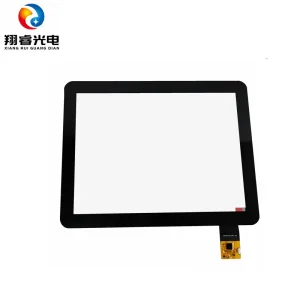
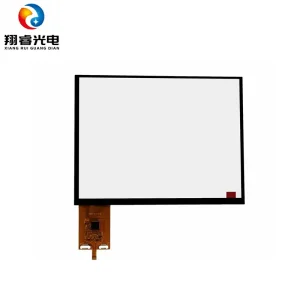
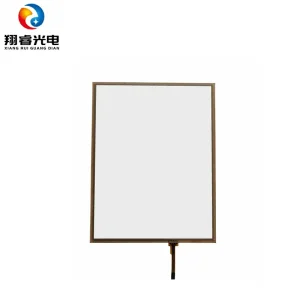
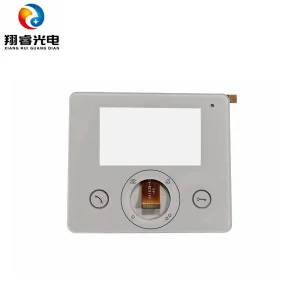
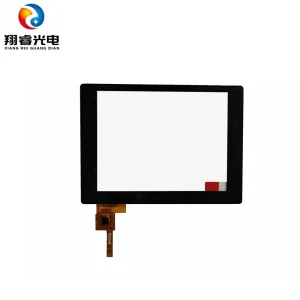
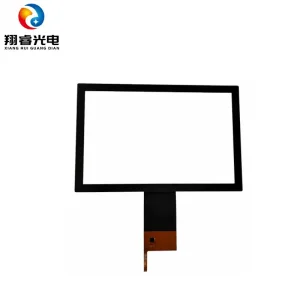
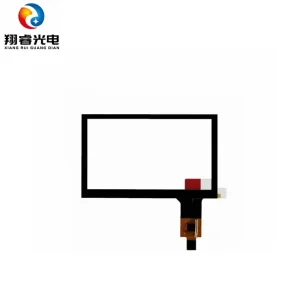
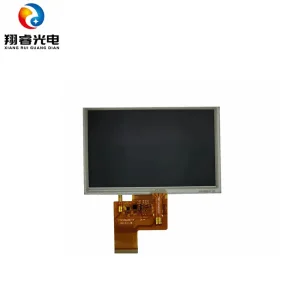
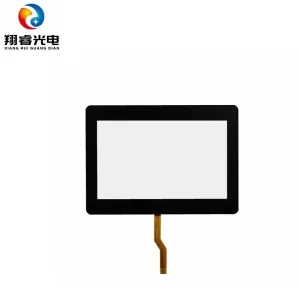
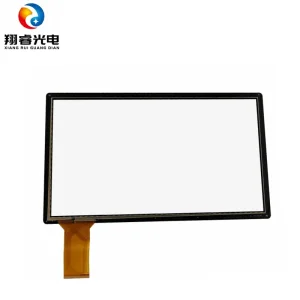
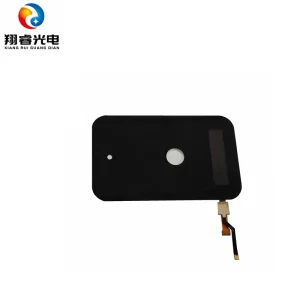
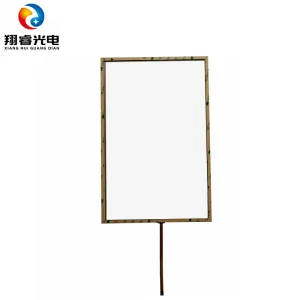
Discover our range of specialized formats, small-to-mid-scale capacitive touch screens, and custom resistive panels built to exact industrial dimensions.
Direct technical answers from our R&D department to help product designers and procurement managers make informed hardware choices.
For large-format displays like 27-inch screens, a Glass-on-Glass (G+G) structure is highly recommended. G+G utilizes a glass sensor layer beneath a glass cover lens, which provides excellent structural integrity, superior thermal stability, and high optical transmittance (typically exceeding 88-90%). G+F structures are more prone to thermal expansion mismatch over large surfaces, leading to warping or delamination in warm environments. Additionally, G+G supports multi-touch performance up to 10 points and resists aging, making it suitable for industrial HMIs, medical monitors, and outdoor kiosks.
Air bonding leaves a small air gap between the touch sensor and the LCD panel. This air gap causes light refraction, which reduces screen readability under bright light and increases internal reflections. It can also lead to condensation in humid environments. Optical bonding fills this gap with Liquid Optical Clear Adhesive (LOCA) or dry tape (OCA), matching the refractive index of the glass. This process offers several key benefits:
Large capacitive sensors can be susceptible to electrical noise from power supplies, high-frequency equipment, and LCD backlights. To prevent coordinate drift and false inputs, we integrate high-end industrial controllers from brands like EETI and Ilitek. We apply custom-tuned firmware configurations, including frequency-hopping algorithms and noise filtering, to ensure stable operation. For demanding environments, we also incorporate hardware shielding layers, such as ITO shielding film, to isolate external electromagnetic interference.
Yes. To achieve IK10 impact ratings (resisting a 20-joule impact from a falling steel ball), we use chemically tempered sodium-calcium or aluminosilicate cover glass, typically 3.0mm to 6.0mm thick. The chemical strengthening process increases surface compression, which significantly enhances resistance to fractures and scratches. We also offer anti-shatter film lamination to ensure that if the glass does break under extreme force, it remains intact without scattering shards.
We provide three main chemical surface treatments for custom touch screen designs:
For custom configurations, the design and tooling phase (including engineering drawings, FPC layout design, and sample tooling) typically takes 3 to 4 weeks. Once prototype designs are approved, sample production takes about 2 to 3 weeks. Mass production lead times generally range from 4 to 6 weeks, depending on batch sizes and components sourcing. We also offer tooling options to help manage initial development costs for small-to-medium volume projects.
 Xiangrui Optoelectronics