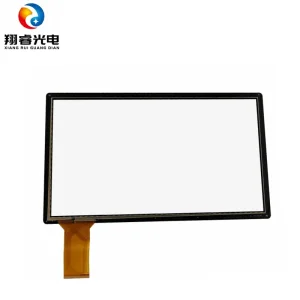
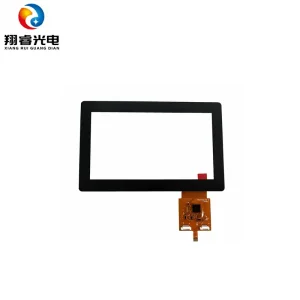
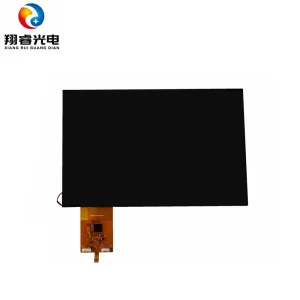
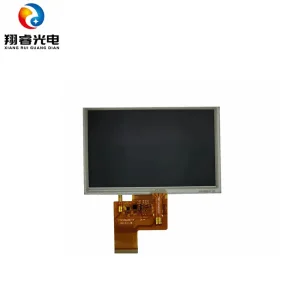
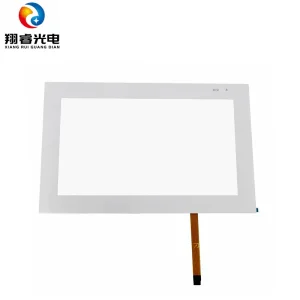
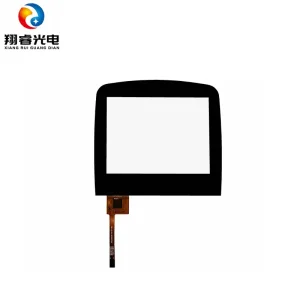
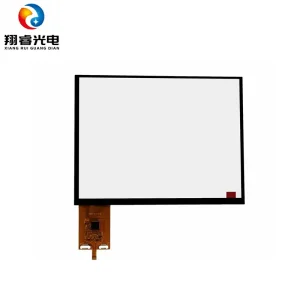
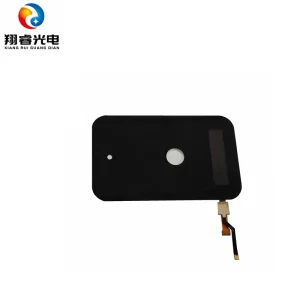
Explore our engineering-ready capacitive and resistive touch products, customized for performance under severe electromagnetic and environmental stresses.
Modern Human-Machine Interfaces (HMI) demand intuitive, fluid, and safe interactions. The transition from single-touch resistive panels to 10-point multi-touch capacitive screens has revolutionized how operators control complex machinery, how clinicians read medical displays, and how consumers transact at point-of-sale (POS) systems.
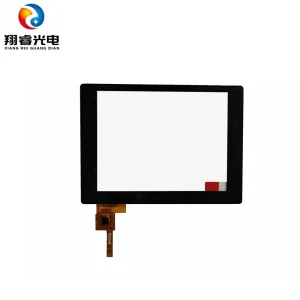
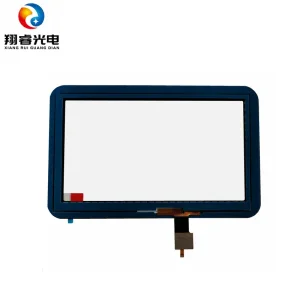
By using a grid of microscopic electrode sensors integrated into the Projected Capacitive (PCAP) display stack, the controller IC measures tiny alterations in electrostatic capacitance. A dedicated touch controller determines coordinates for up to ten independent touch points simultaneously. This multi-touch mapping supports gestures like pinch-to-zoom, rotate, and multi-finger safety controls (e.g., dual-activation requirements for dangerous operations).
B2B procurement is rarely about purchasing an off-the-shelf component. Operating conditions in outdoor, industrial, or medical scenarios require highly custom configurations.
Optical Bonding (LOCA/OCA) fills the air gap between the display panel and the touch screen using opto-grade liquid gel or film. This significantly reduces internal reflections, increases sunlight visibility by up to 400%, and improves mechanical impact resistance.
Choose from AG (Anti-Glare) to diffuse light reflections in bright control rooms, AR (Anti-Reflective) coatings to maximize optical transmission, and AF (Anti-Fingerprint/Oleophobic) layers to ensure clear visuals and effortless cleaning.
We source premium touch controller chipsets (EETI, Ilitek, FocalTech) supporting diverse industrial and medical communication protocols. Standard USB, I2C, and RS232 interfaces ensure rapid hardware integration with modern host platforms.
| Feature / Metric | Projected Capacitive (PCAP) Multi-Touch | Analog Resistive Touch (Single / Gestures) | Optimal Deployment Scenarios |
|---|---|---|---|
| Touch Points | 10-Point Simultaneous Touch Tracking | Single-touch (or 2-point basic pinch gesture) | PCAP for interactive GUIs; Resistive for simple legacy HMI |
| Input Mediums | Bare finger, thin latex gloves, conductive stylus | Gloves (heavy leather/rubber), stylus, pen, fingernail | Resistive excels in heavy-glove chemical assembly environments |
| Transparency / Light Trans. | High transparency (>88% to 92% with Optical Bonding) | Moderate transparency (75% to 85% typical) | PCAP is superior for vivid medical and outdoor screens |
| Scratch & Impact Resistance | Excellent (Cover glass hardness >7H, chemically tempered) | Vulnerable to scratching (PET top sheet outer layer) | PCAP offers high durability against public vandalism |
| Environmental Immunity | Firmware filtering for water droplets, mist, dust | Pressure-based touch operates unaffected by moisture | Resistive handles oil splashes; PCAP handles high wash-down |
Founded in 2010 and headquartered in Guangzhou, China, Guangzhou Xiangrui Optoelectronics Technology Co., Ltd. is a specialized enterprise at the forefront of researching, developing, manufacturing, and distributing resistive touch panels, capacitive touch panels, cover glass assemblies, and complex LCD module bonding solutions. We offer high-tier custom prototyping, OEM scaling, and ODM design engineering.
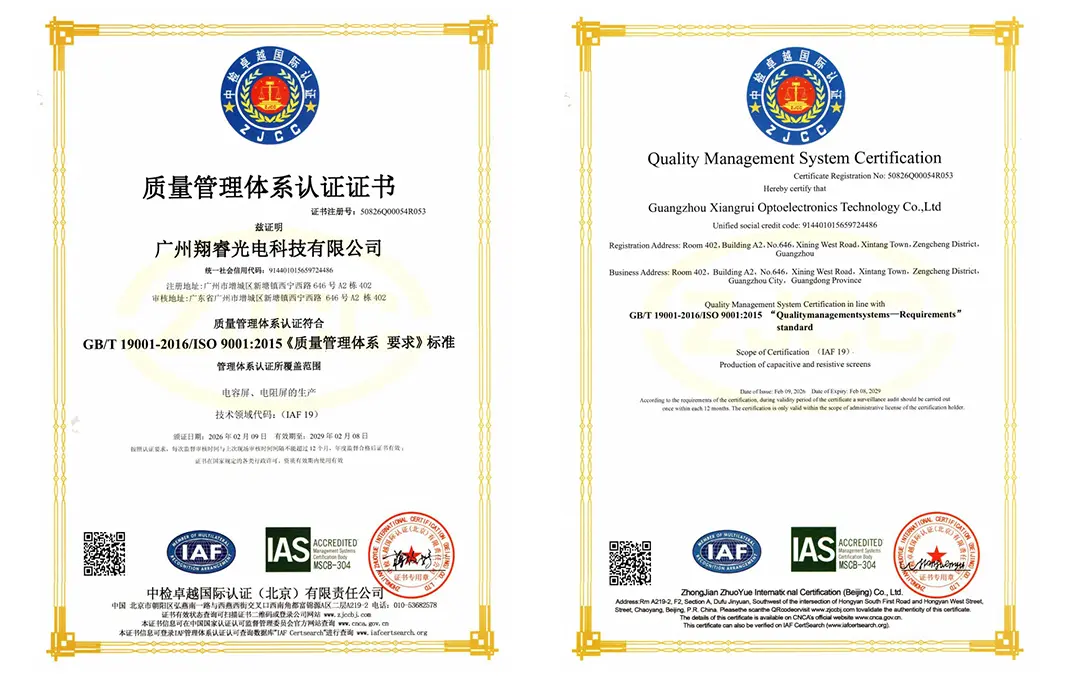
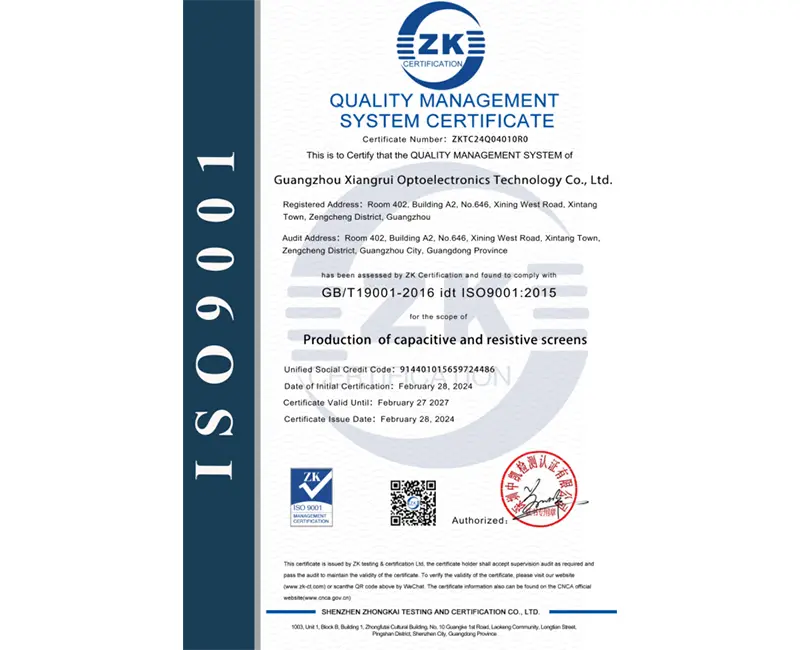
Our operation is strictly compliant with international quality standards. We hold active ISO 9001 (Quality Management) and ISO 14001 (Environmental Management) certifications, ensuring our processes remain consistent, clean, and sustainable. In recognition of our technical contributions, our factory was designated a *Guangdong High-Tech Enterprise* in 2022 and currently holds over 30 utility patents.
Our products are widely integrated across high-reliability industries including clinical medical monitors, industrial system controls, advanced home automation, smart payment networks, palmprint scanners, and extreme-environment marine consoles.
Our products are engineered to operate continuously in demanding settings, from sterile hospital settings to high-vibration manufacturing environments.
Medical touch monitors require absolute sterility and support for gloved operations. Our 10-point capacitive panels are designed to resist aggressive sanitation fluids, prevent accidental activations caused by condensation, and function seamlessly under latex or surgical gloves.
Heavy machinery and electrical cabinets generate high electromagnetic interference (EMI). We implement custom shielding layers (ITO) and industrial-grade controller ICs to maintain touch responsiveness in noisy environments.
Public-facing retail screens, ATM terminals, and palmprint scanners require physical resilience. Our panels use thick, chemically strengthened cover glass (IK08 to IK10 impact ratings) to prevent scratches, physical abuse, and weather wear in outdoor setups.
The core enemy of high-yield touch screen production is airborne particulate pollution. A single dust speck trapped in the optical layer during assembly creates bubbles or visual defects, compromising the integrity of capacitive tracking. To maintain reliable yields, Guangzhou Xiangrui Optoelectronics runs advanced cleanrooms with varying filtration levels tailored to each production step:
Our laminating and critical OCA bonding areas are housed inside a Class 100 dust-free workspace, maintaining extremely low particulate counts. Component printing and baking take place in a controlled Class 1000 cleanroom, while general assembly operates under standard Class 10,000 parameters. Every touch panel undergoes strict visual and functional checks, including thermal cycles (-40°C to +85°C), salt spray corrosion tests, and electrostatic discharge protection audits.
The touch interface industry is rapidly moving toward more robust, intuitive, and seamless designs. We continuously adjust our production to match these shifts.
By increasing touch controller sensitivity, next-gen systems can detect a finger up to 50mm away. This hover sensing allows touchless selections, preventing bacteria spread in clinical environments and public kiosks.
As modern product designs transition from flat to curved profiles, we are refining curved cover glass production and flexible sensor lines to support ergonomic dashboard integrations.
We configure specialized ITO patterns and durable sensor stacks that maintain performance in environments ranging from -30°C to +85°C, ensuring stability in severe outdoor winter climates or near hot furnace systems.
Expert answers to common engineering, integration, and procurement inquiries about multi-touch panels.
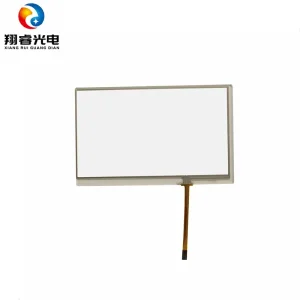
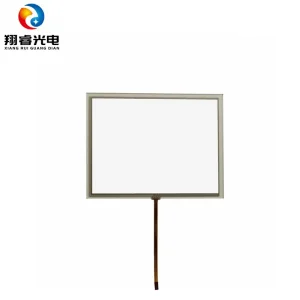
Select specialized resistive and capacitive touch components engineered for industrial machinery, legacy control setups, and harsh chemical environments.
 Xiangrui Optoelectronics