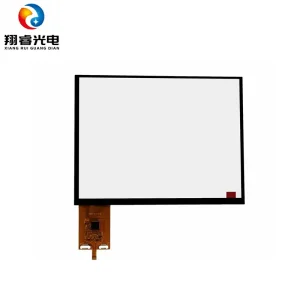
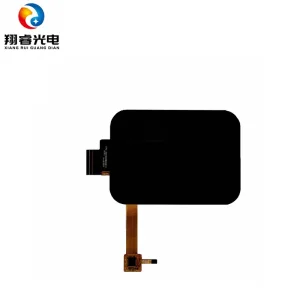
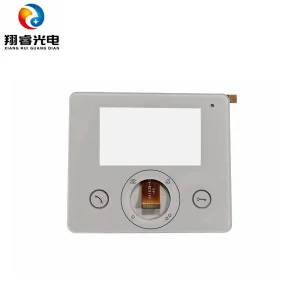
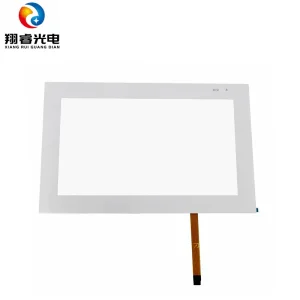
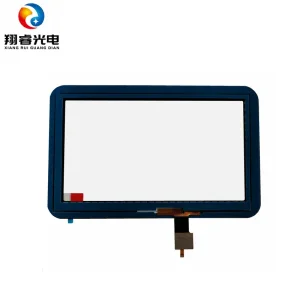
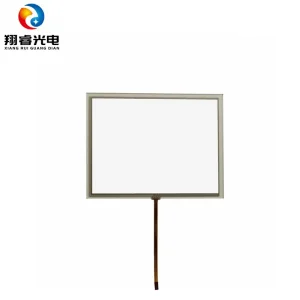
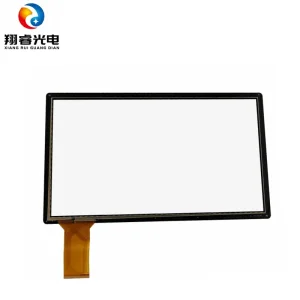
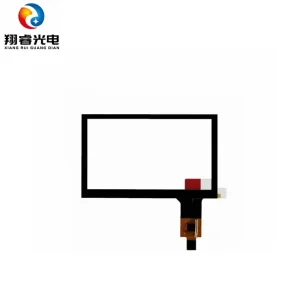
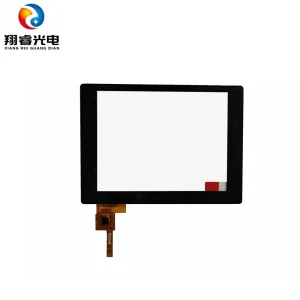
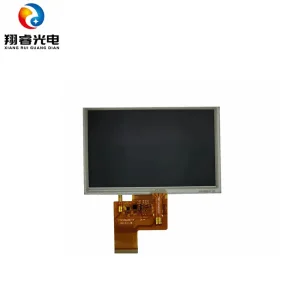
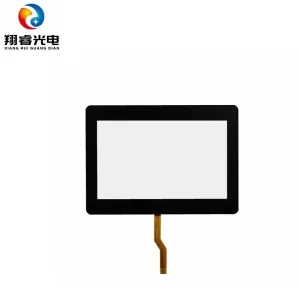
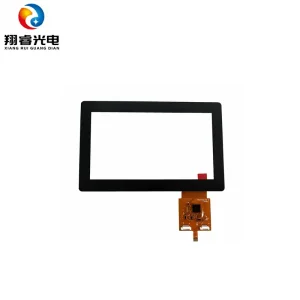
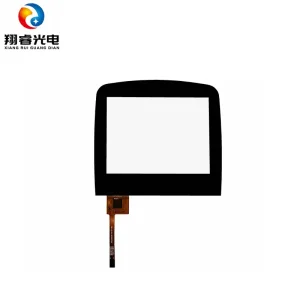
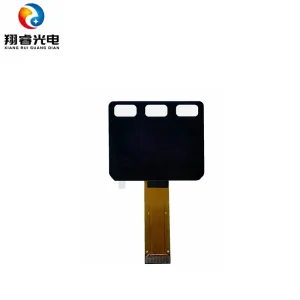
Premium OEM/ODM customizable touch panels featuring optical bonding and heavy-duty IP65 protection.
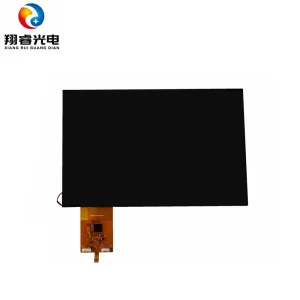
Modern industrial and commercial sectors are transitioning from single-touch mechanical panels to highly complex multi-touch interfaces. Human-Machine Interfaces (HMIs) must now perform under extreme temperatures, EMI (electromagnetic interference) environments, and heavy mechanical stress. Selecting a partner who can customize resistive or capacitive technologies using specialized optical bonding techniques is critical to product lifecycle longevity.
This document details design considerations, supply chain dynamics, and regulatory compliance parameters that direct procurement agents and product engineers analyze when selecting an enterprise-grade OEM/ODM touch panel manufacturer.
Founded in 2010, Xiangrui Optoelectronics has emerged as a premier manufacturer of high-precision touch panel systems. Spanning a state-of-the-art facility equipped with class 100, class 1000, and class 10000 dust-free cleanrooms, we ensure that every sensor layer and cover glass substrate is processed under surgical-grade clean environments.
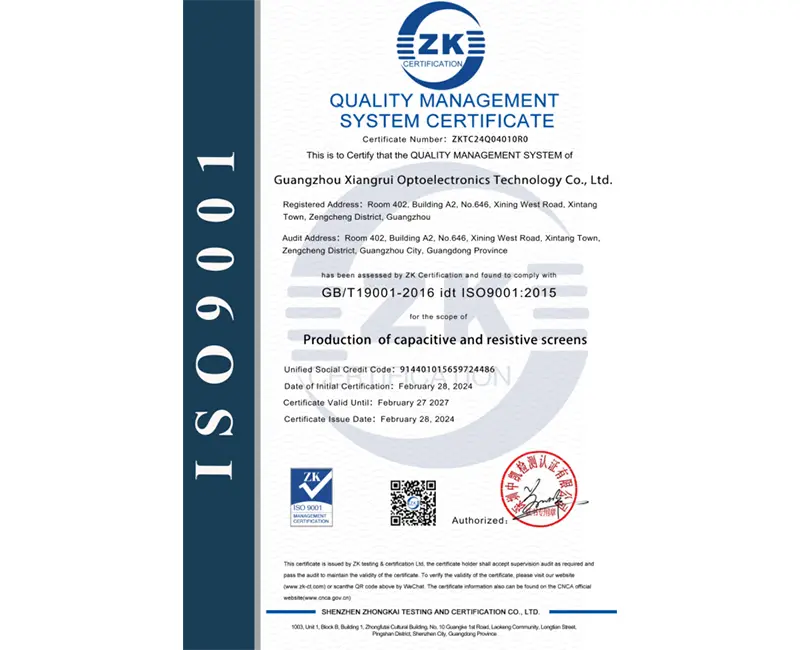
Holding rigorous ISO 9001:2015 Quality Management and ISO 14001:2015 Environmental Management system qualifications, our manufacturing operations are highly standardized. Our product lines feature over 30 patents, ensuring our global clients benefit from cutting-edge design and robust engineering.
A comprehensive comparison for systems engineers to select the optimal touch architecture.
Selecting the right touch interface demands an evaluation of operational environments. Projected Capacitive (PCAP) multi-touch technologies offer exceptional clarity and support multi-touch gestures (pinching, swiping, zooming) along with hardened glass covers for heavy impact protection. Alternatively, Resistive Touch Panels remain crucial in environments where operators wear thick gloves or where severe liquid/dust accumulation causes false triggers on capacitive panels.
By offering customized design paths for both technologies, Xiangrui Optoelectronics facilitates a tailored engineering approach:
Our Optical Bonding processes eliminate internal air layers. This configuration creates a cohesive, single-body unit characterized by:
1. Cover Glass: Hardened glass surface with AG/AR/AF treatment.
2. Optical Adhesive Layer: High-transparency optical bonding gel (OCR/LOCA).
3. Sensor Glass (ITO): Double-layer ITO film or glass sensor array.
4. LCD Display Module: Direct bond integration for high heat dissipation.
*This structural stackup prevents moisture ingress and condensation under high humidity conditions.
How we satisfy the rigorous demands of enterprise supply chains.
Operating under ISO 9001 and ISO 14001, our production lines follow rigorous test protocols including thermal shock testing (-40°C to +85°C), salt spray corrosion tests, and ESD immunity to guarantee long-term system stability.
We source raw components from verified raw material partners to secure multi-year component availability. This prevents unexpected lifecycle changes for critical industrial and medical equipment projects.
Our dedicated engineering department designs and produces test-ready CAD models and prototypes in as little as 10 to 15 working days. This rapid validation process helps significantly reduce overall time-to-market.
Deploying optimized multi-touch arrays built to withstand extreme application environments.
Industrial settings require components that resist oil, dust, and continuous mechanical stress. Our 10.1-inch and 15.6-inch industrial-grade panels feature IP65 sealing, high chemical resistance, and support for gloved operation. These features enable continuous operation on busy production lines without sacrificing accuracy.
Medical-grade displays must perform reliably in sterile environments. We construct our touch screens to support cleaning with harsh disinfectants. Our customized firmware prevents false touch signals caused by dripping water, saline solutions, and surgical gel, ensuring compliance with strict healthcare standards.
Integrating high-resolution small-format screens, such as our 3.5-inch and 4.0-inch custom panels, into home automation systems and handheld devices provides user-friendly HMI touchpoints. Our low-power, thin profile sensors integrate seamlessly into compact product enclosures.
Outdoor kiosks, marine navigators, and point-of-sale systems face extreme challenges from direct sunlight and fluctuating temperatures. We design touch displays with wide operating temperature limits (-30°C to +80°C), thermal management layers, and high-brightness backlights to ensure stable performance.
We provide end-to-end ODM/OEM support. This includes custom cover glass printing, FPC connector restructuring, touch controller firmware tuning, optical bonding integration, and custom housing design.
Our target milestones in product design and material integration.
We are continuously developing new materials and designs to meet the evolving requirements of next-generation control systems. Our research focuses on increasing durability, reducing frame widths, and improving touch responsiveness under challenging environmental conditions.
Developing low-resistance metal mesh and silver nanowire sensors to enable ultra-flexible, curved touch displays for vehicle dashboards and smart office automation.
Incorporating localized micro-vibration tactile arrays. This provides operators with physical confirmations of inputs without needing to look at the display, enhancing safety in medical and automotive settings.
Integrating palm print and fingerprint sensors directly into the active matrix of the capacitive panel to secure outdoor ticketing and financial transaction kiosks.
Detailed technical answers addressing common deployment and manufacturing questions.
Air Bonding seals the touch sensor and LCD display along their outer borders, leaving an air gap between them. This gap can cause internal reflections, lower optical clarity in bright light, and allow dust or moisture condensation over time. Optical Bonding fills this gap with an Optical Clear Resin (OCR or LOCA). This process eliminates internal reflections, improves visibility in direct sunlight, prevents condensation, and enhances the screen's resistance to mechanical shocks.
Water conducts electricity and can trigger false touch signals on capacitive touch panels. To address this, we optimize the touch controller firmware (using systems like EETI or ILITEK) with water-rejection algorithms. The controller measures changes in capacitance to distinguish between the continuous coverage of water droplets and the distinct touch of a finger, maintaining accurate touch responses even when wet.
Yes. We can customize the thickness of the cover glass, using chemically strengthened glass (soda-lime or aluminosilicate) from 3mm to 6mm thick. This thickness, combined with precise chemical tempering, allows the touch screen to meet IK10 impact criteria, protecting the sensor array from severe physical impacts in public kiosks or industrial facilities.
We support multiple interface standards to fit different processing systems. For capacitive systems, we commonly implement I2C and USB interfaces. For resistive systems, we offer 4-wire, 5-wire, and 8-wire analog outputs. Additionally, we customize the routing and shape of Flexible Printed Circuits (FPCs) to match the internal layout of your product enclosures.
Quality control is integrated throughout our production process. Operating under ISO 9001, we conduct incoming material inspections, cleanroom optical checks, electrical parameter tests, and automated calibration. Before shipment, every panel undergoes automated testing to verify touch accuracy, linearity, and signal-to-noise ratios.
Explore our complete range of resistive and capacitive touch panels designed for global supply networks.
 Xiangrui Optoelectronics