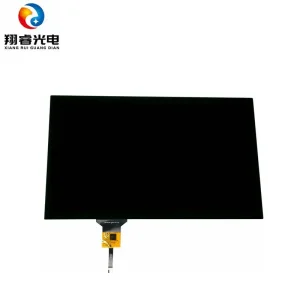
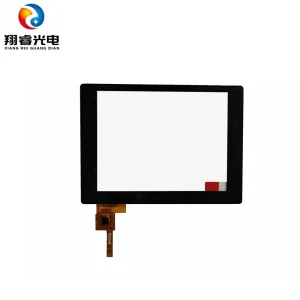
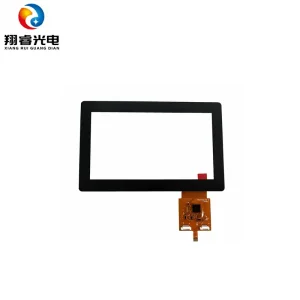
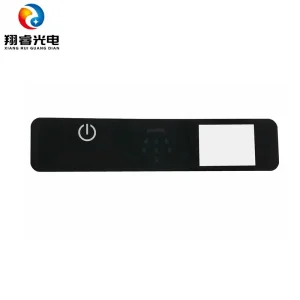
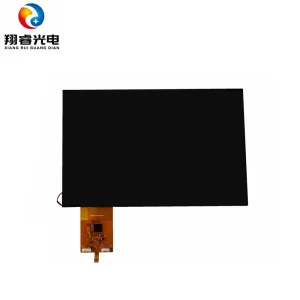
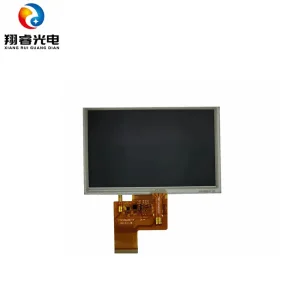
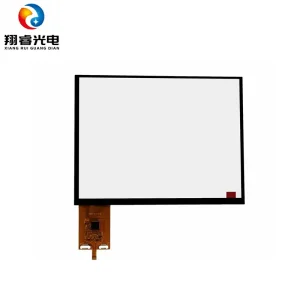
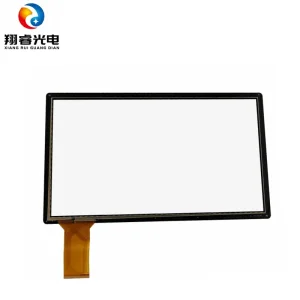
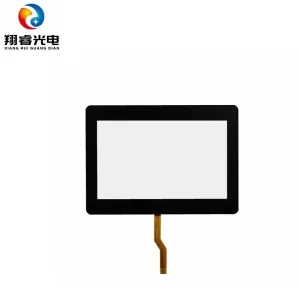
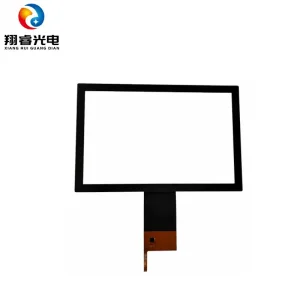
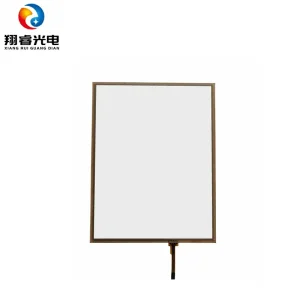
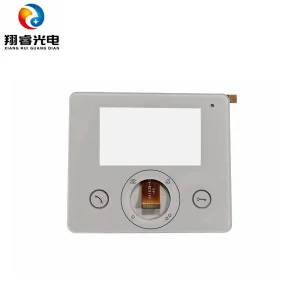
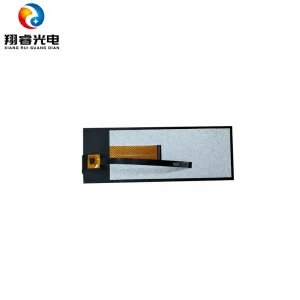
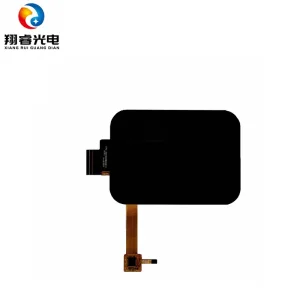
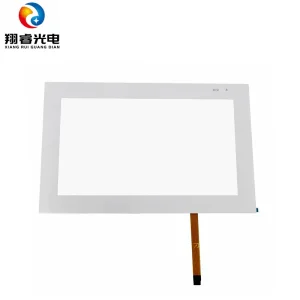
Explore our advanced Projected Capacitive (PCAP) and Resistive touch panel selections designed for high reliability, wide-temperature ranges, and rugged environments.
Technological Convergence & High-Reliability Demands Across Commercial and Heavy-Industrial Markets
Today, an OEM touch screen manufacturer must possess deep expertise across material science, electronics engineering, and environmental sealing. Factors such as outdoor readability, resistance to solar radiation (UV degradation), multi-touch operability with heavy industrial gloves, and noise rejection under electrical interference have turned the humble display panel into a highly specialized piece of industrial equipment.
1. Optical Bonding Domination: The conversion from air-gap bonding to optical bonding (using Liquid Optically Clear Adhesive - LOCA or sheet-based OCA) to eliminate internal reflections, improve optical clarity, and bolster mechanical impact resistance.
2. Specialized Cover Glass Treatments: Extensive deployment of Anti-Glare (AG), Anti-Reflective (AR), and Anti-Fingerprint (AF) coatings to tackle harsh ambient lighting and heavy-duty usage.
3. Heavy Noise Rejection: Integration of advanced controller ICs (such as EETI, Ilitek, and FocalTech) programmed with high-frequency scanning algorithms to ensure flawless touch output even when exposed to severe electromagnetic interference (EMI).
Aligning Engineering Parameters with Application Requirements
Selecting the correct touch technology determines the operational efficiency and lifetime value of an industrial device. A critical decision point for systems architects is choosing between Projected Capacitive (PCAP) and Resistive touch architectures. While PCAP is the modern standard for gesture control and multi-touch capability, Resistive touch panels remain essential in fields requiring high pressure-sensitivity and absolute immunity to EMI or liquid contamination.
| Feature Parameter | Projected Capacitive (PCAP) | Resistive Touch (4-Wire / 5-Wire) | Industrial Value Advantage |
|---|---|---|---|
| Touch Principle | Electrostatic field alteration by human body capacitance | Mechanical contact bringing conductive ITO layers together | PCAP requires no activation force; Resistive supports any stylus/glove |
| Durability & Lifetime | Virtually limitless (tested beyond 50 million touches) | Approx. 1 to 35 million actuations in localized points | PCAP utilizes rugged cover glass (up to 7H hardness) for wear immunity |
| Optical Performance | High transparency (>88% default, up to 92% with Optical Bonding) | Lower transparency (typically 75% - 82%) due to air gaps | Optical bonding prevents condensation, dust ingress, and internal glare |
| Environmental Sealing | IP65, IP67 dust/waterproof with custom front cover glass | Subject to wear; flexible PET polyester top layer can puncture | PCAP handles chemical cleaning, outdoor precipitation, and abrasives |
| Input Mediums | Bare finger, conductive stylus, thin surgical/nitrile gloves | Finger, gloved hand, plastic pen, any mechanical pointer | Industrial PCAP can be tuned for heavy industrial gloves & moisture rejection |
A Globally Recognized OEM/ODM Touch Panel Manufacturer
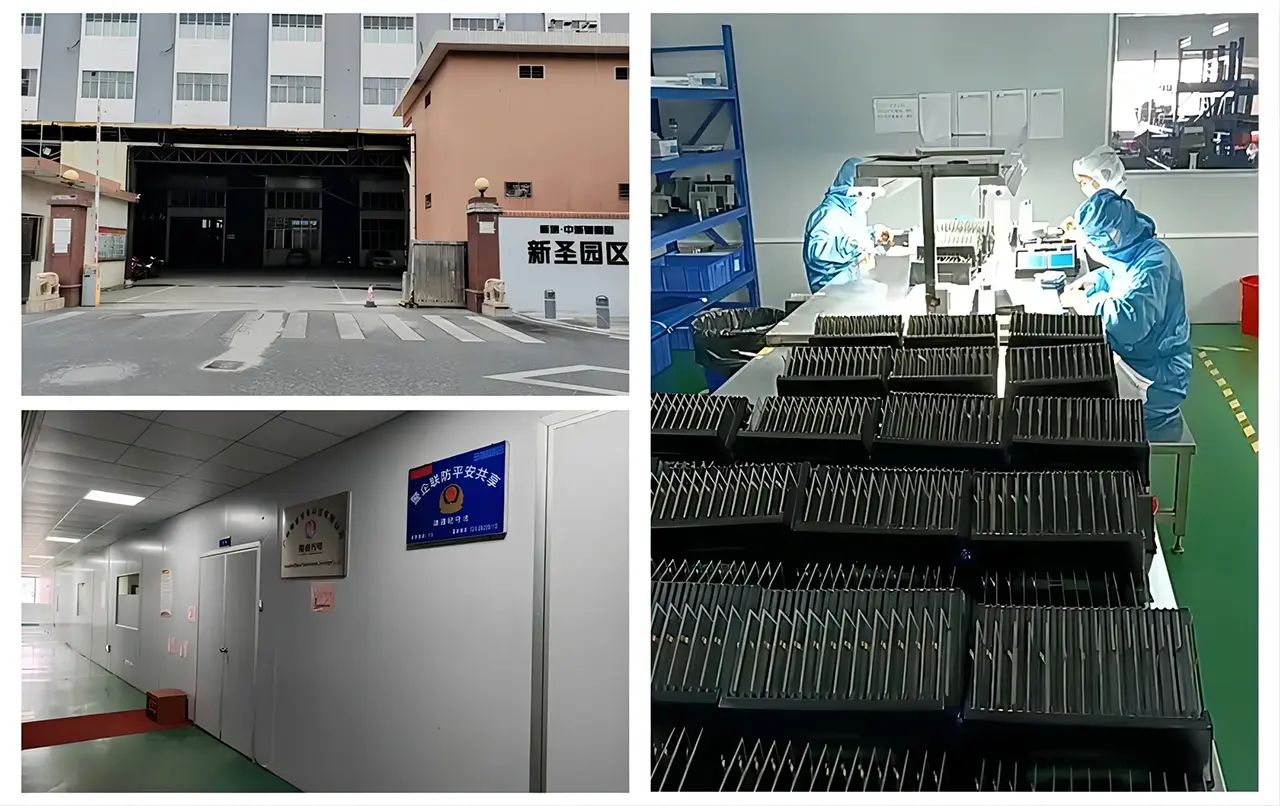
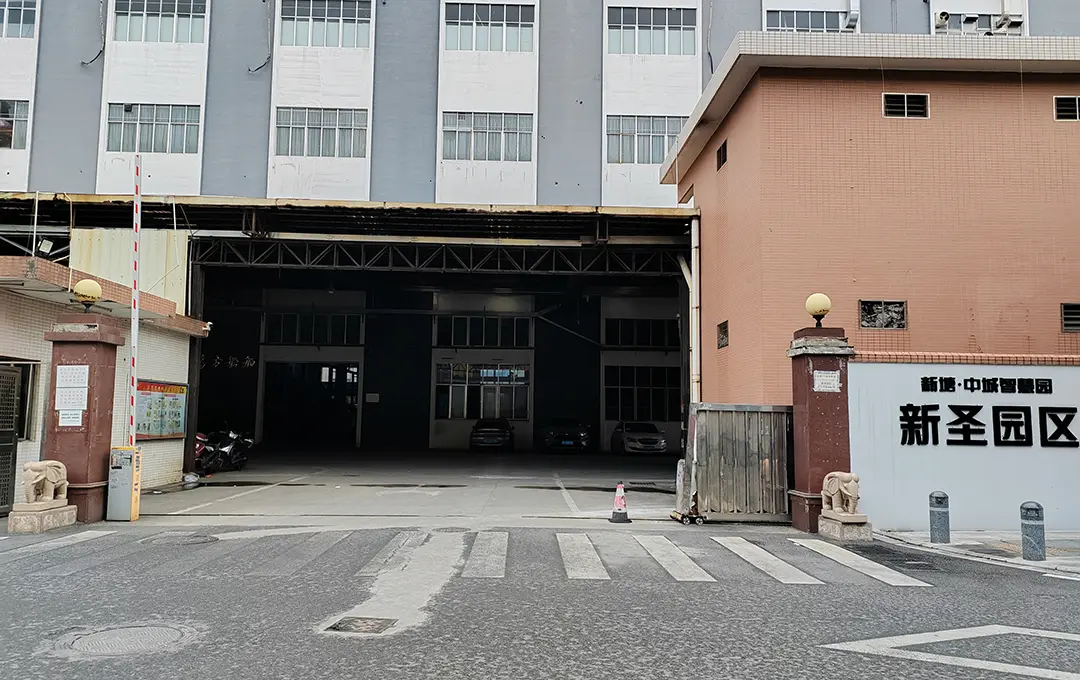
Founded in 2010, Guangzhou Xiangrui Optoelectronics Technology Co., Ltd. has developed into an industry-leading enterprise dedicated to the R&D, manufacturing, sales, and technical service of high-tier resistive touch panels, capacitive touch panels, cover glass, and complete liquid-crystal module bonding. Our 3,000 square meter state-of-the-art production plant (located within a 10,000 square meter facility envelope) is fully equipped with highly regulated Class 100, Class 1,000, and Class 10,000 dust-free workshops. These cleanrooms are critical in maintaining the pristine cleanliness required for high-yield optical bonding, OCA lamination, and sensor-to-glass processes.
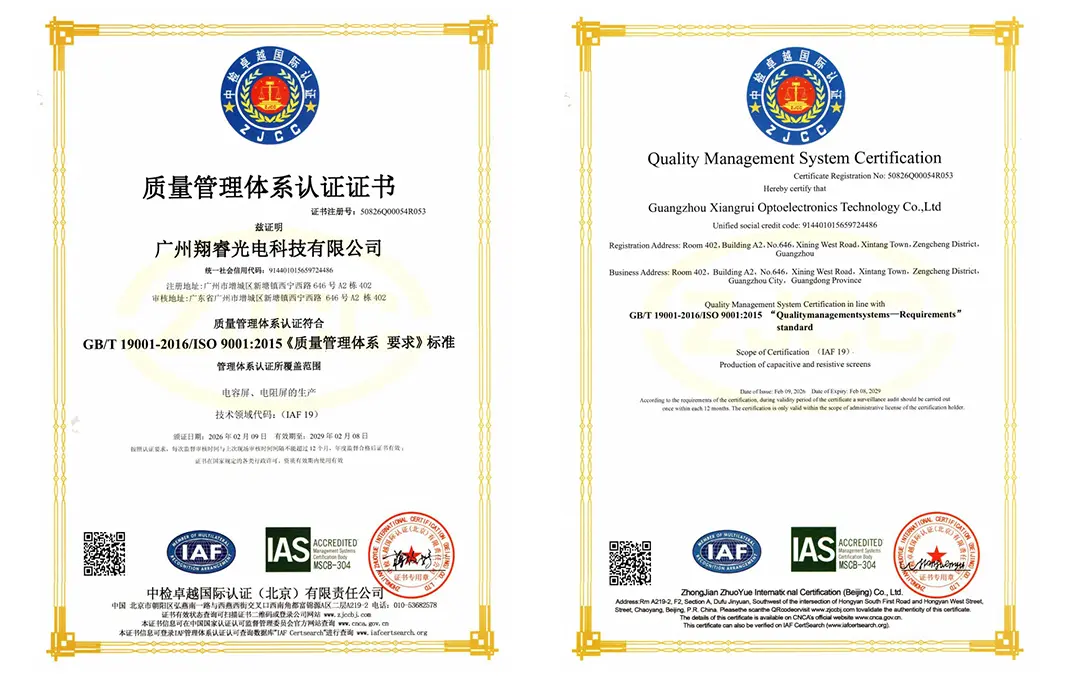
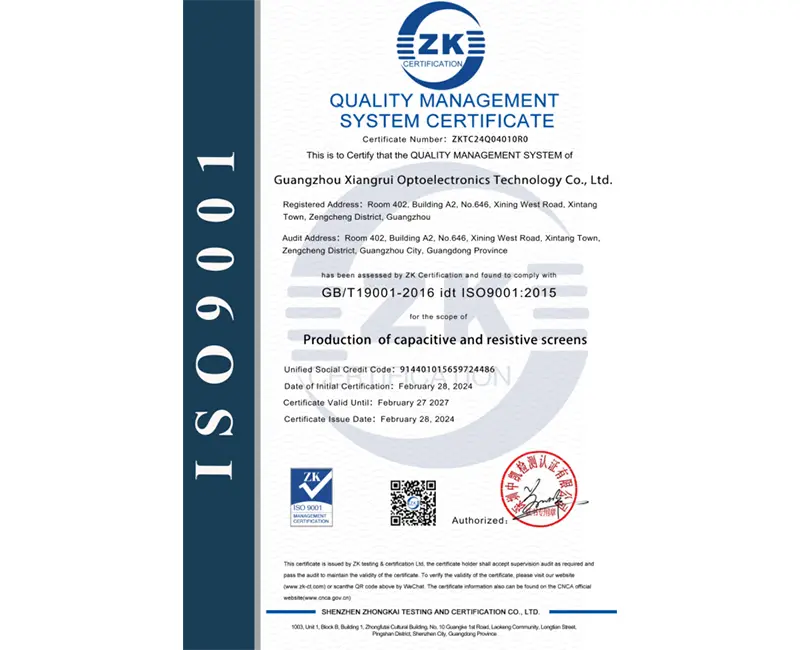
We are deeply committed to international manufacturing standards, holding full ISO 9001:2015 and ISO 14001:2015 certifications. By continuously investing in advanced material research, new process engineering, and product durability testing, we have secured more than 30 national patents and were honored as a "High-Tech Enterprise of Guangdong Province" in 2022.
From Initial Design and Prototyping to Industrial Lamination and Long-term Lifecycle Management
At Guangzhou Xiangrui Optoelectronics, we operate with a client-first philosophy, building long-term partnerships with leading global enterprises and display distributors. Our technical process is highly structured, ensuring that every touch screen meets stringent performance criteria from raw material verification to final cosmetic and functional inspection.
Custom glass tailoring with thicknesses ranging from 0.5mm to over 10mm (vandal-proof IK10 ratings). Cover glass shapes can be chemically strengthened, thermally tempered, silk-screen printed with brand graphics, and custom machined with holes or bevels.
We offer frame-fitting (tape bonding) and full optical bonding. Full optical bonding eliminates the air gap between the display panel and the touch sensor, improving durability, removing moisture fogging, and enhancing display contrast under direct sunlight.
We write, test, and inject customized firmware into major controller ICs. This optimizes signal-to-noise ratios, enables thick glove operations, supports multi-point touch under running water, and handles custom communication protocols like USB, I2C, and RS232.
How Our Touch Technology Powers Critical Global Infrastructures
 Industrial Automation & HMI
Our wide-temperature resistive and capacitive touch screens are designed for continuous 24/7 use in factories. Engineered with dust-proof seals, vibration dampening, and advanced electromagnetic protection, these displays maintain touch precision near heavy electric motors and high-voltage gear.
Hygiene is paramount in medical settings. Our custom capacitive screens support flat, seamless cover glass designs that are easy to clean and sanitize. They are tuned to recognize touch input from latex, nitrile, and surgical gloves while resisting cleaning chemicals.
With high-transmission glass and specialized anti-glare/anti-reflective coatings, our touch screens deliver clear visibility under direct sunlight. Integrated water-rejection firmware prevents false touches from rain or humidity, ensuring reliable public use in kiosks and outdoor terminals.
How Guangzhou Xiangrui Optoelectronics is Adapting to Tomorrow's HMI Standards
Guangzhou Xiangrui is actively developing next-generation solutions to meet these requirements:
Standard ITO (Indium Tin Oxide) can be brittle when applied to curved surfaces. We are developing Metal Mesh and silver nanowire technologies to enable reliable touch tracking on curved panels and flexible industrial housings.
By integrating piezo-electric actuators behind the touch screen stack, we provide tactile feedback to users. This physical response helps operators confirm input without looking directly at the screen, increasing safety in critical industrial processes.
We are working on integrating advanced touch controllers that process basic gestures locally on the display chip. This reduces the processing load on the system CPU and speeds up screen response times.
Technical & Engineering Solutions for System Designers and Global Buyers
Select specialized resistive, capacitive, and high-transmission bonded panels below to view physical drawing specs and detailed electrical profiles.
 Xiangrui Optoelectronics