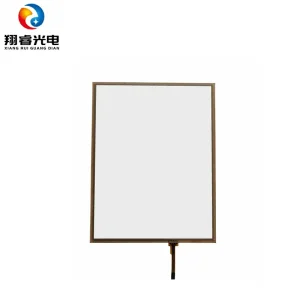
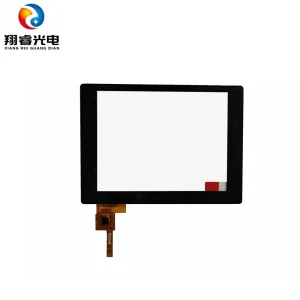
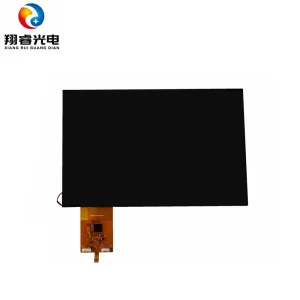
Explore our high-performance display integrations engineered for extreme reliability and optimized sunlight readability.
In modern electronic display fabrication, the standard structural gap left between a cover glass (or touch panel) and the underlying liquid crystal display (LCD) or organic light-emitting diode (OLED) panel represents a severe vulnerability. Known to engineers as the air-gap configuration, this empty space allows dust, moisture, and condensation to accumulate, while causing substantial optical degradation.
Optical display bonding is the precise manufacturing process of filling the physical air gap between the display panel and the cover lens with an optical-grade adhesive. This adhesive possesses a refractive index ($n \approx 1.5$) that closely matches both the cover glass and the polarizer surface. By neutralizing the air-to-glass interfaces ($n = 1.0 \to 1.5$), internal light reflection is reduced from a typical 4.5% to under 0.2%. This creates a dramatic improvement in contrast ratio, luminance efficiency, and sunlight readability.
When light passes through interfaces with different refractive indices, refraction and reflection occur. By matching the refractive index of the adhesive (LOCA or OCA) with the glass substrate, we eliminate internal reflections, enhance display luminance by up to 20%, and increase mechanical impact absorption by up to 300% compared to traditional perimeter tape bonding.
Design engineers must select the appropriate bonding medium based on panel size, geometry, environmental conditions, and mechanical limits. As a premier custom display factory, we operate specialized production lines for both Liquid Optically Clear Adhesive (LOCA) and Optically Clear Adhesive (OCA) tape.
| Performance Parameter | Liquid Optically Clear Adhesive (LOCA/OCR) | Optically Clear Adhesive (OCA Tape) |
|---|---|---|
| Physical State | Liquid resin (Silicone / Polyurethane / Acrylic) | Pre-cured dry adhesive sheets |
| Best Suited Panel Size | Excellent for all sizes (especially >15.6 inches) | Best suited for handheld & small displays (<10.1 inches) |
| Surface Topography | Conforms perfectly to uneven surfaces & step-ink margins | Limited conformity; vulnerable to bubbles around high ink margins |
| Reworkability | Highly reworkable before and during curing phases | Difficult; prone to damaging polarizers during removal |
| Impact Resistance | Superb; absorbs high kinetic energy through liquid elastomeric damping | Moderate structural shock absorption |
Founded in 2010, Guangzhou Xiangrui Optoelectronics Technology Co., Ltd. is a high-tech enterprise based in Guangzhou, China. We specialize in the research, development, and high-volume production of resistive touch panels, capacitive touch panels, cover glass customizations, and comprehensive module optical bonding services.
With a state-of-the-art facility spanning over 3,000 square meters, we operate specialized cleanrooms certified up to Class 100, Class 1000, and Class 10000. This cleanroom hierarchy maintains zero-tolerance particle thresholds, eliminating dust contamination risks during critical optical laminations.
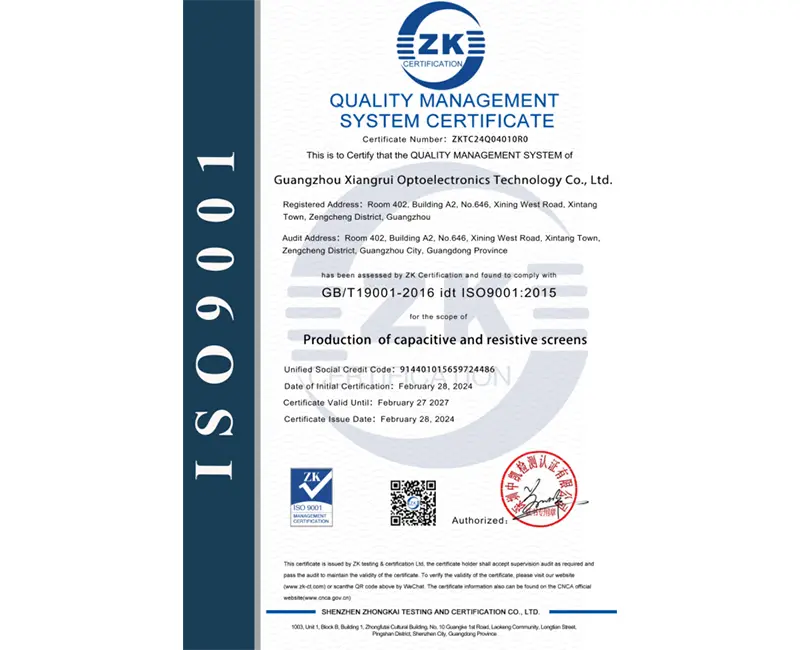
Our operational systems comply with ISO 9001:2015 Quality Management and ISO 14001:2015 Environmental Management systems. Over the past decade, we have secured more than 30 utility patents and invention patents, earning the prestigious "High-Tech Enterprise of Guangdong Province" title in 2022.
The global display manufacturing supply chain is heavily anchored in South China, particularly within the Pearl River Delta. Choosing Guangzhou Xiangrui Optoelectronics Technology Co., Ltd. as your manufacturing partner offers several strategic advantages:
We are situated within walking distance of prime material suppliers, including cover glass manufacturers, high-purity optical adhesive producers, and LED backlight fabricators, significantly reducing lead times.
Our in-house CNC glass cutting, chemical tempering, and custom jig-making enable rapid iterations from design phase to functional prototypes in as little as 10 to 14 days.
Equipped with vacuum bonding chambers, automated fluid dispensers, and UV-curing conveyor assemblies to maintain consistent optical properties and yield rates over large runs.
As smart technology integration accelerates across the globe, industrial displays face increasingly demanding performance standards. The following industry trends dictate how modern custom optical bonding assemblies are designed:
By combining custom touch designs and advanced optical laminations, we deliver complete display solutions for various application scenarios:
Guangzhou Xiangrui Optoelectronics Technology Co., Ltd. ensures that every batch of display assemblies meets rigorous international quality protocols. Our quality assurance framework features several testing gates:
Assemblies undergo thermal shock tests (-40°C to +85°C, 100 cycles) and constant high-temperature, high-humidity storage tests (60°C, 90% RH for 500 hours) to verify adhesion integrity.
We verify optical performance using high-resolution spectrophotometers, ensuring total light transmittance levels above 99% and haze levels below 1%.
Using ASTM G154 weathering standards, we test cured assemblies with continuous UV radiation exposure to prevent future yellowing, delamination, or bubble formulation.
Expert insights on display lamination, touch integration, and manufacturing specifications.
Air bonding (or frame fitting) secures the cover glass to the LCD screen border using double-sided adhesive tape, leaving an air gap in the middle. Optical bonding fills this gap completely with an optical-grade liquid or solid adhesive. Optical bonding eliminates internal reflections, prevents internal condensation, improves impact resistance by transferring load forces, and significantly enhances contrast and readability under direct sunlight.
LOCA (Liquid Optically Clear Adhesive) is a liquid resin that can easily conform to uneven surfaces, custom bezel lines, and heavy-step ink borders. This makes it ideal for displays larger than 10.1 inches. OCA (Optically Clear Adhesive) is a solid tape sheet that is challenging to laminate bubble-free over larger surfaces or over thick silk-screened ink lines, making OCA more suitable for smaller consumer devices like smartphones.
When a display suffers a physical impact, an air gap acts as an empty void, concentrating the stress on the cover glass or LCD surface. Under optical bonding, the cured adhesive layer acts as a solid mechanical cushion. It absorbs and distributes kinetic energy across the entire structure, which significantly improves impact resistance and keeps shattered glass from scattering.
We perform all clean-up, adhesive dispensing, and initial UV cure steps inside certified Class 100 cleanroom zones. To eliminate microscopic bubbles, the bonded modules are placed in custom autoclave chambers under regulated temperature and high atmospheric pressure, dissolving remaining gas pockets into the adhesive resin.
Yes, utilizing specialized debonding systems, we can safely separate and clean components bonded with LOCA or custom silicones. This allows the reclamation of expensive high-resolution LCD panels or custom cover lenses, reducing scrap rates and keeping long-term maintenance costs down.
Engineered to withstand demanding environments, our high-temperature and IP-rated touch modules ensure long-term durability.
 Xiangrui Optoelectronics