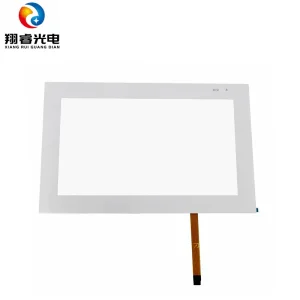
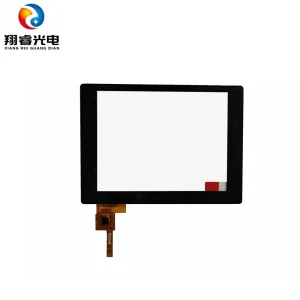
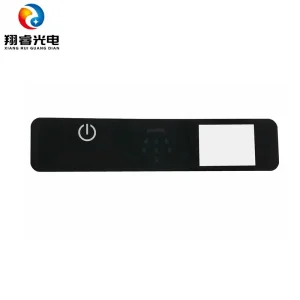
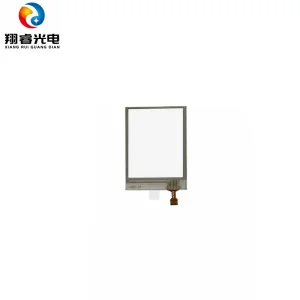
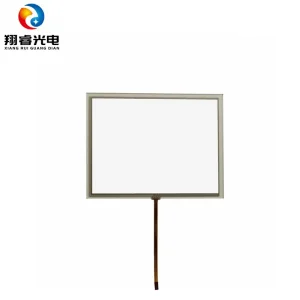
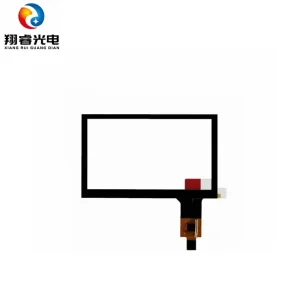
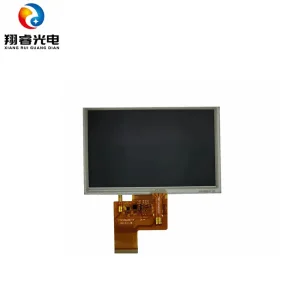
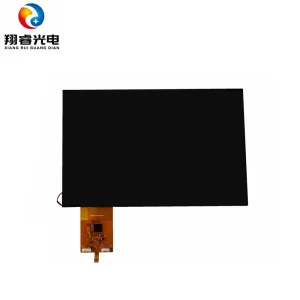
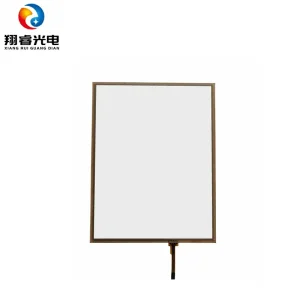
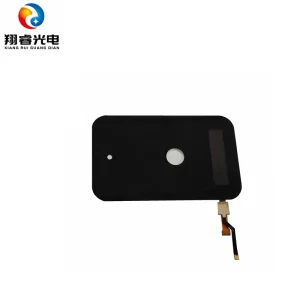
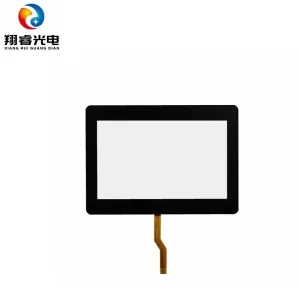
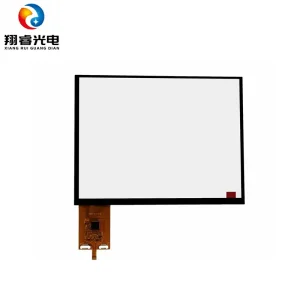
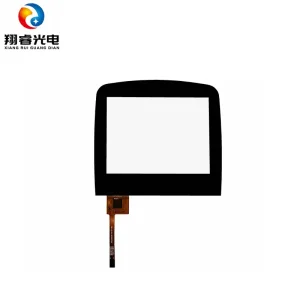
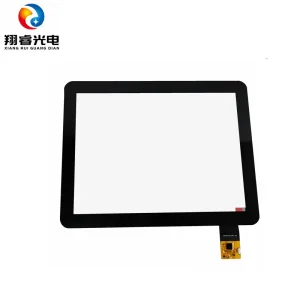
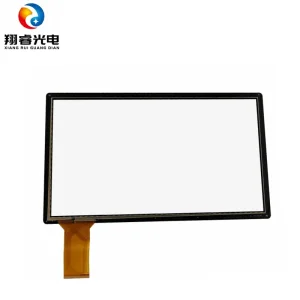
OEM Industrial Touchscreen Panel Suppliers & Factories

High-Performance Projected Capacitive & Resistive HMI Touch Modules Engineered for Harsh Global Industrial Environments

Guangzhou Xiangrui Optoelectronics Technology Co., Ltd.

Pioneering Cleanroom Industrial Interface Engineering Since 2010

For more than a decade, Guangzhou Xiangrui Optoelectronics Technology Co., Ltd. has established itself as an authoritative leader in China's advanced display and industrial touch module domain. Operating out of our specialized 3,000 square meter factory within a modern 10,000 square meter site, we provide end-to-end research, production, cover glass fabrication, and precise optical bonding integration services.

Through sustained investment in engineering and process compliance, we ensure that our resistive and capacitive touch modules meet the rigorous physical and environmental demands of systems operating in complex sectors such as medical instruments, specialized industrial HMIs, smart utility automation, defense avionics, and payment kiosks.
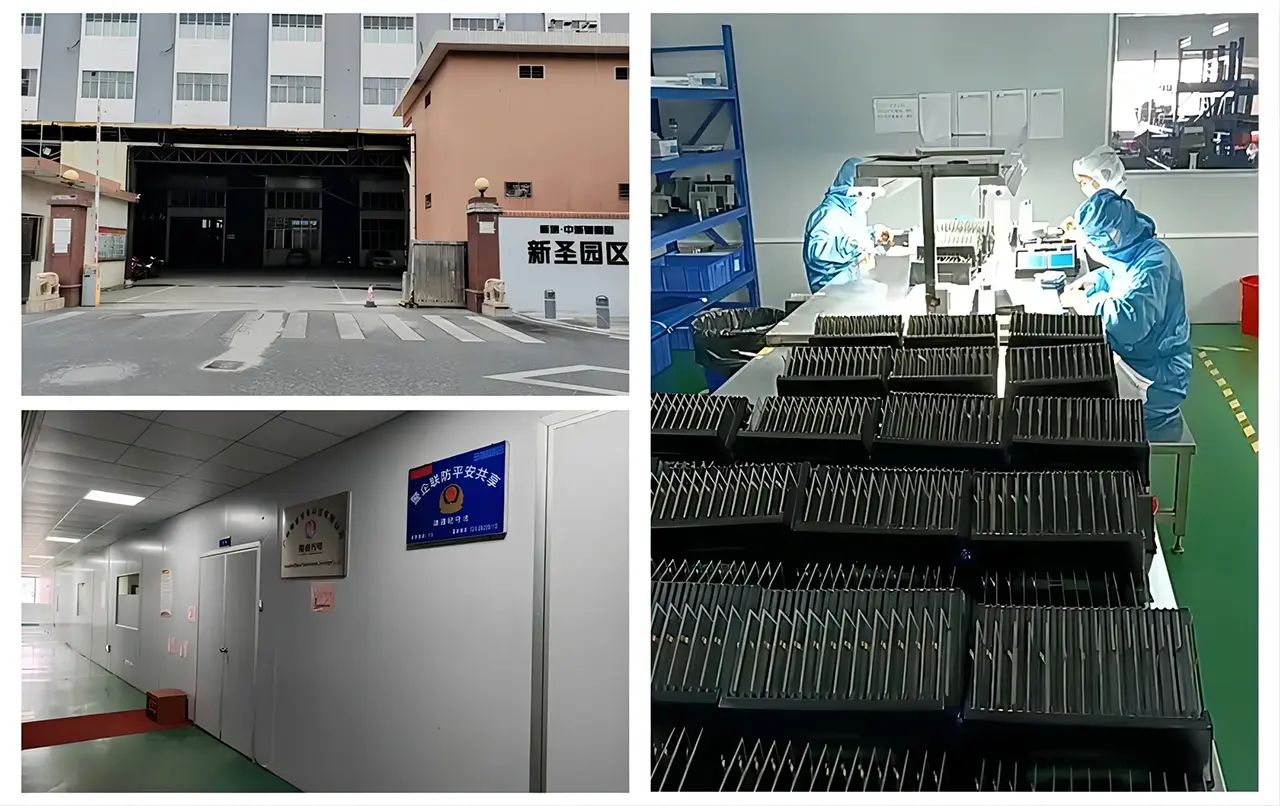
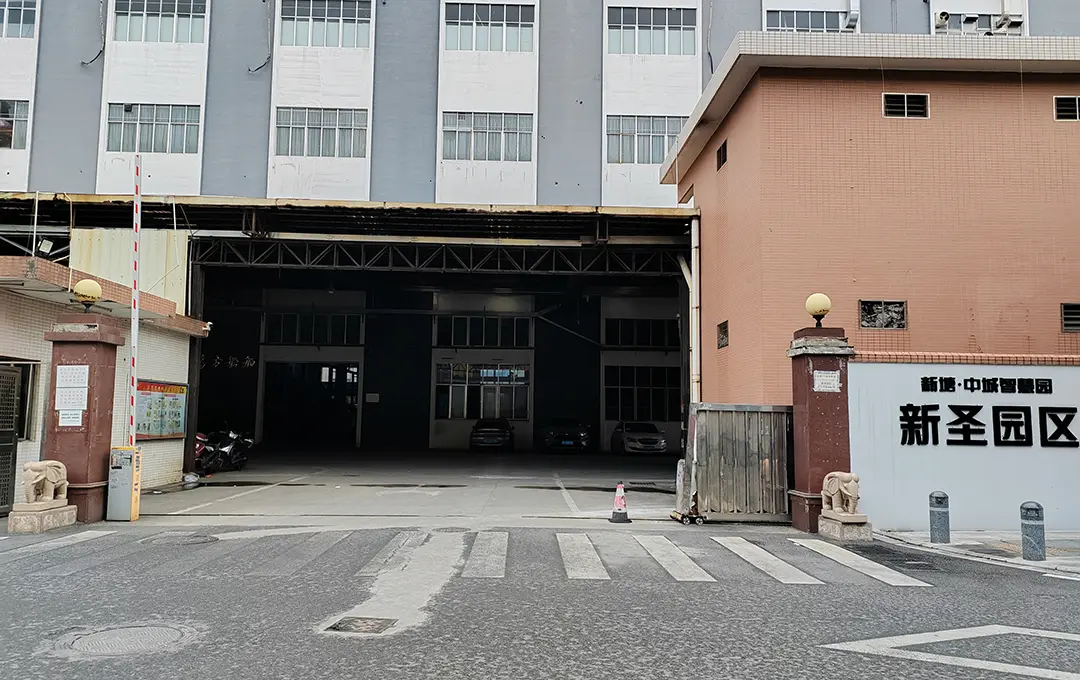
Guangzhou Xiangrui Optoelectronics Cleanroom Facility
ISO 9001 & ISO 14001 Registered Factory Floor: Continuous air filtering and temperature control protect visual components from static and dust particle ingress during bonding.
10+ Yrs
Industrial Heritage
Refining OEM/ODM processes since 2010.
30+
Invention Patents
Proprietary active pen, thick-glass touch & EM shielding methods.
Class 100
Controlled Cleanrooms
Class 100, 1,000 & 10,000 dust-free fabrication zones.
40+
Export Nations
Global logistics supporting projects across America, Europe, and Asia.
Engineering Reference Whitepaper

Resistive vs. Projected Capacitive (PCAP) Touch Architecture

Understanding structural differences, shielding layers, and environmental tolerances is vital to choosing the right system interface.

Industrial computers require durable touch interfaces optimized for harsh environments. Choosing between Projected Capacitive (PCAP) and Resistive technologies depends on environmental variables, operations constraints, and display parameters.

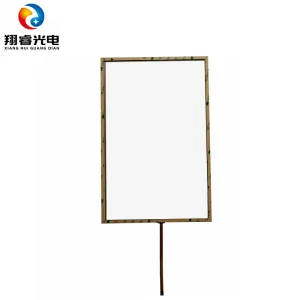
Resistive touch screens operate on pressure-activated mechanical contact. When a stylus, gloved hand, or bare finger applies physical force, the flexible upper PET film layer presses against the bottom glass layer, closing the electrical loop. Because it relies on pressure rather than electrical properties, resistive screens are immune to liquid surface interference, high electromagnetic fields, and non-conductive debris. This makes them ideal for marine consoles, mining equipment, and industrial automation dashboards where operators wear thick insulated gloves.

Conversely, Projected Capacitive (PCAP) touch screens measure microscopic changes in electrostatic capacitance. Utilizing a matrix of micro-fine sensor electrodes deposited onto optical film or glass, PCAP screens support multi-touch gestures, offer high optical clarity (over 90% transmission), and feature scratch-resistant cover glass (up to 7H Mohs).
Functional Parameter Resistive Touch Architecture Projected Capacitive (PCAP) Touch Engineering Notes
Operating Force Mechanical pressure (typically 10g to 100g) Zero force required (conductive contact) PCAP offers high wear resistance with no moving parts.
Glove Support Supports all gloves (heavy leather, thermal, chemical) Requires controller tuning for thick industrial gloves Our customized firmware adapts threshold settings for thick gloves.
Optical Light Transmittance 75% – 82% (restricted by multiple PET layers) > 90% (> 92% with specialized optical bonding) PCAP is better for high-ambient sunlight readability.
Surface Hardness & Ruggedness 3H Mohs (soft outer film, vulnerable to scratches) 6H to 7H Mohs (tempered cover glass) IK08/IK10 ratings require PCAP with thick cover glass.
Moisture and Liquid Immunity Complete resistance (droplets do not affect activation) Requires dynamic firmware calibration to filter out water Our PCAP touch screens feature wet-finger operation algorithms.
Multi-touch Support Single-touch or dual-touch gestures Multi-touch (typically 10-point touch tracking) Gestures (pinch, swipe) are only supported on PCAP.
Cleanroom Bonding Processes and High Tech Quality Assurance
Cleanroom Assembly (Class 100): Precision optical and frame bonding processes prevent dust ingress and maintain low reflection profiles under high sun load.
Advanced Integration Technologies

Optical Bonding & Cover Lens Engineering

For critical outdoor installations, we offer Optical Bonding (LOCA/OCA) to eliminate the air gap between the touch sensor and the underlying LCD panel. This prevents internal condensation and matches the refractive index of the materials to reduce glare by up to 400%.

Our custom cover lenses feature specialized surface treatments to handle tough conditions:

  • Anti-Glare (AG): Uses chemical etching to scatter reflected light, perfect for bright industrial floors.
  • Anti-Reflection (AR): Uses vacuum-sputtered multi-layer coatings to maximize light transmission.
  • Anti-Fingerprint (AF): Uses oleophobic coatings to resist oil, dirt, and water, keeping screens clean.
Application-Specific Engineering

Macro-Industry Target Integration Solutions

How we tailor touchscreen panels to meet the strict demands of specific industrial sectors.

Medical Equipment & Diagnostics

Medical systems require precise touch inputs that work reliably even with latex gloves or during disinfection. Our capacitive touch modules are tuned to function with surgical gloves and resist harsh medical disinfectants.

Standards: EN 60601-1 Medical Safety, ISO 13485 (Compatible Assembly)
Industrial HMI Panels

Heavy machinery creates continuous vibrations and electromagnetic interference. Our ruggedized resistive and PCAP touch controllers are shielded against EMI, preventing false touch inputs.

Standards: IP65 Waterproof Front Bezel, IK08-IK10 Resistance
Smart Home & Touch Kiosks

Public kiosks and smart home systems require attractive, durable glass surfaces with fast touch response. We offer customized 2.5D cover glass with integrated borders and high optical clarity.

Standards: Custom Cover Glass Silkscreening, Multi-Touch support
Strict Quality Management

ISO Certified Production Flow & Testing

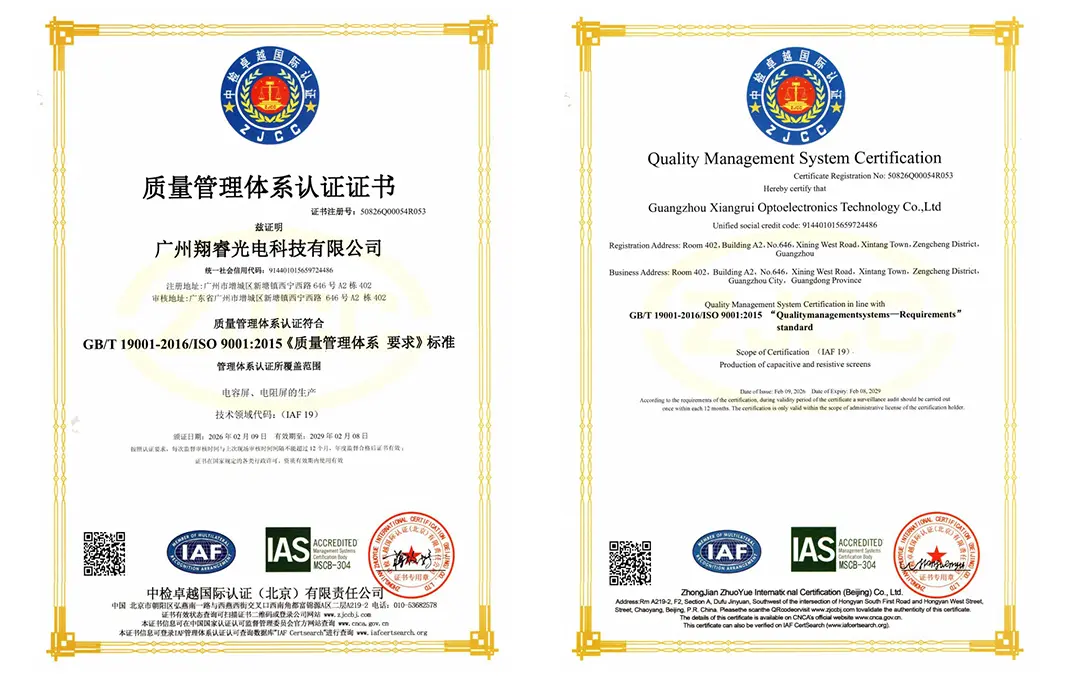
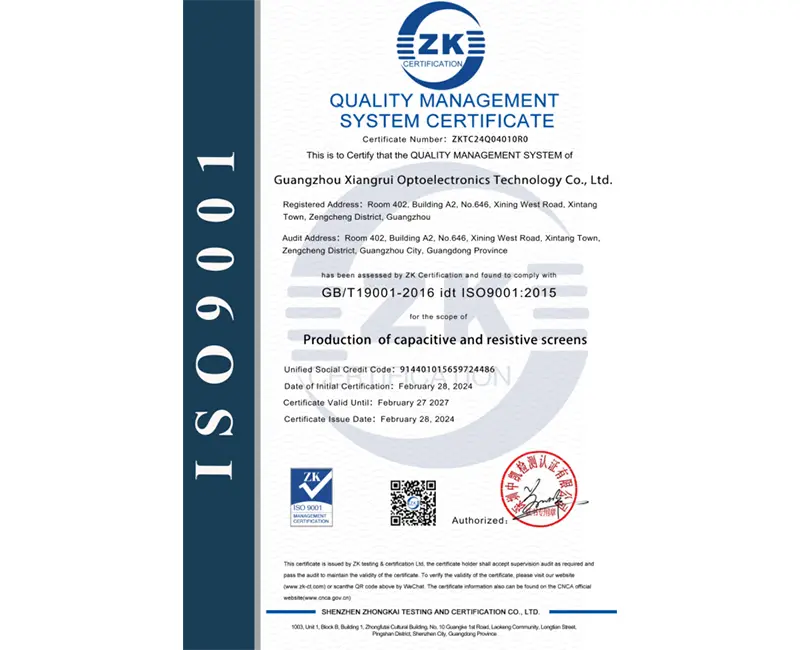
Our quality control protocols follow international standards. As an ISO 9001 and ISO 14001 registered manufacturer, Guangzhou Xiangrui Optoelectronics ensures that every material layer, circuit trace, and controller chip is thoroughly inspected.

To guarantee long-term reliability in the field, we perform comprehensive environmental testing:
  • Thermal Cycle Exposure: Testing performance across wide operating ranges from -30°C to +85°C.
  • ESD and Interference Testing: Ensuring compliance with CE/FCC electromagnetic regulations.
  • Life Cycle Verification: Confirming resistive films can handle over 35 million inputs and PCAP layers over 50 million.
Comprehensive Quality Assurance Facility Testing
Quality Control Laboratory: Touch controller boards undergo automated testing to ensure consistent calibration before final shipment.
Raw Touch Screen Manufacturing Material Sorting
Raw materials are inspected for optical clarity and flatness, ensuring touch sensor panels meet strict quality guidelines.
Engineering Center for Touch Calibration
Our engineering team designs custom layouts, tuning controllers for I2C, USB, and RS232 interfaces to match client requirements.

Technology Awards

Recognized as a Guangdong Province High-Tech Enterprise, we hold over 30 patents for touch sensors and cover glass manufacturing methods.

Technology Roadmap

Future Developments in Touchscreen Design

Our research focus matches the evolving needs of modern human-machine interface (HMI) systems.

Phase 1

Ultra-Thick Cover Glass

Developing PCAP controllers that can register touches through cover glass up to 15mm thick, meeting strict IK10 safety requirements.

Phase 2

Flexible Sensors

Developing flexible touch sensors and silver nanowire films to support curved, lightweight dashboard displays.

Phase 3

Haptic Touch Feedback

Integrating localized haptic feedback actuators to give operators tactile confirmation without looking at the screen.

Phase 4

Advanced Anti-Microbial Glass

Fusing silver-ion formulas into the cover glass structure to provide long-lasting hygiene protection for medical and public kiosks.

Industrial Buyer Guide

Frequently Asked Technical Questions

Direct technical answers to help engineering and sourcing departments select the right touch technology.

What are the key differences between Optical Bonding and Air Bonding (Tape)? +
Air bonding secures the touch sensor to the LCD using double-sided adhesive tape around the borders. This leaves a small air gap in the middle, which can trap moisture and cause reflection. Optical bonding fills this gap with a liquid optical clear adhesive (LOCA) or solid optical film (OCA). This eliminates internal reflections, improves optical clarity, and prevents moisture or dust from building up between the layers.
How do you configure PCAP controllers to work with industrial gloves? +
We use specialized controllers (such as EETI, Ilitek, or Microchip) and customize the firmware parameters. By adjusting threshold values and noise filters, we can tune the sensor to detect capacitance changes through thick leather, latex, or specialized work gloves.
Can your touchscreen solutions withstand high electromagnetic noise (EMI)? +
Yes, our industrial touch panels are built with EMI shielding layers and high-voltage controller drivers. This makes them highly resistant to interference from motors, power supplies, and radio frequencies, ensuring consistent touch inputs.
What custom options do you offer for cover glass? +
We can customize cover glass thickness (from 0.7mm to 10mm), chemically strengthen the material, add custom border prints, and apply specialized coatings like Anti-Glare (AG), Anti-Reflective (AR), and Anti-Fingerprint (AF).